Bibliographie Histoire concours primaire et indicative pour l’agrégation – Les différents points de la lettre de cadrage sont documentés.
Manuels et atlas
Bugh G. R. (dir.), The Cambridge Companion to the Hellenistic World, Cambridge, CUP, 2006.
Cabanes P., Le Monde hellénistique. De la mort d’Alexandre à la paix d’Apamée (323-188 av. J.-C.), Paris, Seuil, 1995.
Carlier P., Le IVe siècle grec jusqu’à la mort d’Alexandre, Paris, Seuil, 2014.
Chamoux F., La Civilisation hellénistique, Paris, Arthaud, 1985.
Clancier P., Coloru O., Gorre G., Les mondes hellénistiques : du Nil à l’Indus, Paris, Hachette Supérieur, 2017.
Droysen J. G., Geschichte des Hellenismus, vol. II, Geschichte der Bildung des hellenistischen Staatensystemes, Hamburg, Perthes, 1843.
Fernoux H.-L., Legras B., Yon J.-B., Cités et royaumes de l’Orient méditerranéen. 323-55 av. J.-C., Paris, Armand Colin, 2003.
Grandjean C. et alii, Le monde hellénistique, Paris, Armand Colin, 2017².
Martinez-Sève L., Atlas du monde hellénistique (336-31 av. J.-C.) : pouvoir et territoires après Alexandre le Grand, Paris, Autrement, 2014.
Préaux C., Le Monde hellénistique : la Grèce et l’Orient (323-146 av. J.-C.), Paris, PUF, 20036.
Thonemann P., The Hellenistic Age, Oxford, OUP, 2016.
Will E., Histoire politique du monde hellénistique 323-30 av. J.-C., Paris, Seuil, 2003².
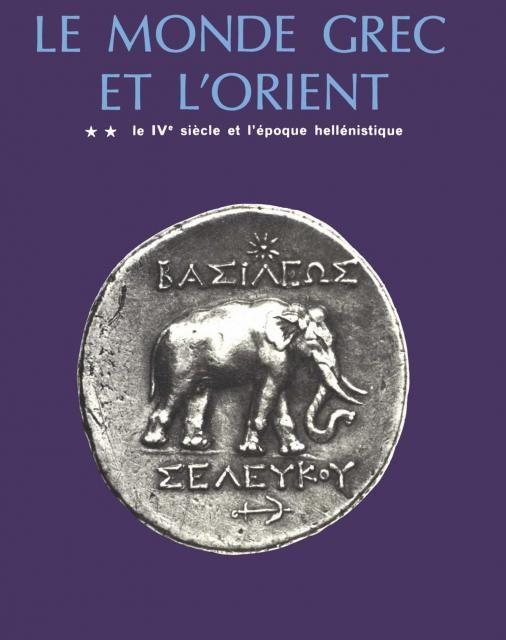
Will E., Mossé C., Goukowski P., Le Monde grec et l’Orient, tome II : le IVe siècle et l’époque hellénistique, Paris, PUF, 1993².
Empire perse achéménide (connaissances générales)
Briant P., Histoire de l’Empire perse de Cyrus à Alexandre, Paris, Fayard, 1996.
Brosius M., A History of Ancient Persia : The Achaemenid Empire, Hoboken, Wiley-Blackwell, 2021.
Jacobs B., Rollinger R., A Companion to the Achaemenid Persian Empire, Hoboken, Wiley, 2021.
Kuhrt A., The Persian Empire, Londres-New York, Routledge, 2007.
Waters M., Ancient Persia : A Concise History of the Achaemenid Empire, 550-330 BCE, Cambridge, CUP, 2014.

Le Monde grec et l’Orient jusqu’à Philippe II
Adcock F., Mosley D.J., Diplomacy in Ancient Greece, New York, St. Martin’s Press, 1975.
Bouzid-Adler F., Les relations entre Grecs et Perses en Asie Mineure occidentale à l’époque achéménide (VIe-IVe siècle av. J.-C.), Thèse de doctorat, Strasbourg, 2016.
Brosius M., « Persian Diplomacy. Between ‘Pax Persica’ and ‘Zero-Tolerance’ », in Milker J. (dir.), Maintaining Peace and Interstate Stability in Archaic and Classical Greece, Mayence, Antike, 2012, p. 150–163.
Canali De Rossi F., I greci in Medio Oriente ed Asia centrale : dalla fondazione dell’Impero persiano fino alla spedizione di Alessandro Magno (550-336 a.C. circa), Rome, Herder, 2007.
Cawkwell G., The Greek Wars. The Failure of Persia. Oxford, OUP, 2005.
Childs W., « Lycian Relations with Persians and Greeks in the Fifth and Fourth Centuries re–examined », AnatSt, 31, 1981, p. 55–80.
Debord P., L’Asie Mineure au IVe siècle (412-323 a.C). Pouvoir et jeux politiques, Bordeaux, Ausonius, 1999.
Descat R. (dir.), L’or perse et l’histoire grecque, Revue des Études Anciennes, 91, 1-2, 1989.
Higgins W. E., Hirsch S. W., The Friendship of the Barbarians : Xenophon and the Persian Empire, Hanovre (New Hampshire), University Press of New Hampshire, 1985.
Hofstetter J., Die Griechen in Persien : Prosopographie der Griechen im persischen Reich vor Alexander, Berlin, Reimer, 1978.
Hyland J. O., Persian Interventions : The Achaemenid Empire, Athens, and Sparta, 450–386 BCE, Baltimore, Johns Hopkins University Press, 2017.
Kousoulis P., Magliveras K. (dir.), Moving across borders : foreign relations, religion, and cultural interactions in the ancient Mediterranean, Louvain, Peeters, 2007.
Lane Fox R., The Long March. Xenophon and the Ten Thousand, New Haven-Londres, Yale University Press, 2004.
Lenfant D. (dir.), Les Perses vus par les Grecs. Lire les sources classiques sur l’empire achéménide, Paris, Armand Colin, 2011.
Lenfant D., « Le rôle de la proxénie dans les relations diplomatiques entre Grecs et Perses », Ktèma, 41, 2016, p. 275-287.
Lewis D. M., Sparta and Persia, Leyde, Brill, 1977.
Mariggiò V. A., Greci e Persiani : storia delle relazioni diplomatiche (550-386 a.C.), Monteroni di Lecce, Esperidi, 2013.
Morgan J., Greek perspectives on the Achaemenid Empire : Persia through the looking glass, Édimbourg, Edinburgh University Press, 2016.
Mosley D. J., Envoys and Diplomacy in Ancient Greece, Wiesbaden, Naiden, 1973.
Rung E., « War, Peace and Diplomacy in Graeco-Persian Relations from the Sixth to the Fourth Century B.C. », in de Souza P., France J. (dir), War and Peace in Ancient and Medieval History, Cambridge, CUP, 2008, p. 28-50.
Rutherford I., Greco-Egyptian interactions : literature, translation, and culture, 500 BCE-300 CE, Oxford, OUP, 2016.
Ruzicka S., Politics of a Persian Dynasty. The Hecatomnids in the Fourth Century B.C., Norman, University of Oklahoma Press, 1992.
Starr C. G., « Greeks and Persians in the fourth century BC. A study of cultural contacts before Alexander, part 1 », Iranica Antiqua, 11, 1976, p. 39-99.
Starr C. G., « Greeks and Persians in the fourth century BC. A study of cultural contacts before Alexander, part 2 », Iranica Antiqua, 12, 1977, p. 49-115.
Trundle M., Greek Mercenaries. From the Late Archaic Period to Alexander, Londres-New York, Routledge, 2004.
Tuplin C., « Greek Mercenaries in Mesopotamia : The Visit of the Ten Thousand », in Da Riva R., Lang M., Fink S. (dir.), Literary Change in Mesopotamia and Beyond and Routes and Travellers between East and West, Münster, Zaphon, 2019, p. 259-284.
Tuplin C., « Xenophon, Isocrates and the Achaemenid Empire : History, Pedagogy and the Persian Solution to Greek Problems », Trends in Classics, 10, 1, 2018, p. 13-55.
Tuplin, C., « Mercenaries and Warlords in the Achaemenid Empire », in Ñaco del Hoyo T., López Sánchez F. (dir.), War, Warlords, and Interstate Relations in the Ancient Mediterranea, Leyde, Brill, 2017 p. 15-35.
Walser G., Hellas und Iran : Studien zu den griechisch-persischen Beziehungen vor Alexander, Darmstadt, Wissenschaftliche Buchgesellschaft, 1984.
Waterfield R., Xenophon’s retreat : Greece, Persia, and the end of the Golden Age, Cambridge, HUP, 2006.
Philippe II
Fündling J., Philipp II. von Makedonien, Darmstadt, Ph. von Zabern, 2014.
Kienast D., Philipp II. von Makedonien und das Reich der Achaimeniden, Munich, Fink, 1973.
Worthington I., Philippe II, roi de Macédoine : stratège, diplomate, créateur d’empire, Paris, Economica.
Alexandre le Grand
Borza E. N., The Impact of Alexander the Great, Hinsdale, Dryden Press, 1974.
Briant P., Alexandre le Grand : de la Grèce à l’Inde, Gallimard, Paris, 2005².
Briant P., Alexandre le Grand, Paris, PUF, 20117.
Green P., Alexander of Macedon, 356–323 BC. : A Historical Biography, Berkeley, University of California Press, 2013².
Heckel W., Who’s who in the age of Alexander the Great : a prosopography of Alexander’s empire, Oxford, Blackwell, 2006.
Heckel W., In the Path of Conquest : Resistance to Alexander the Great, Oxford, OUP, 2020.
Holt F. L., Alexander the Great and Bactria. The Formation of a Greek Frontier in Central Asia. Leyde, Brill, 1988.
Holt F. L., Into the Land of Bones : Alexander the Great in Afghanistan, Berkeley-Londres, University of California Press, 2005.
Roisman J. (dir.), Brill’s Companion to Alexander the Great, Leyde, Brill, 2002.
Royaumes hellénistiques et diadoques
Biagio V., Lancia, diadema e porpora : il re e la regalità ellenistica, Pise, Giardini, 2003².
Bilde P. et alii, Aspects of Hellenistic Kingship, Aarhus, Aahrus University Press, 1996.
Bopearachchi O., Bromberg C. A., Grenet F., Alexander’s legacy in the East : studies in honor of Paul Bernard, Bloomfield Hills, Asia Institute, 2001
Bosworth A. B., The Legacy of Alexander : Politics, Warfare, and Propaganda under the Successors, Oxford, OUP, 2002.
Briant P., « Institutions perses et institutions macédoniennes : continuités, changements et bricolages », in Sancisi–Weerdenburgh H. et alii (dir.), Achaemenid History, Leyde, Brill, 1994, p. 283–310.
Briant P., Joannès F. (dir.), La Transition entre l’empire achéménide et les royaumes hellénistiques, Paris, De Boccard, 2006.
Boehm R., City and empire in the age of the successors : urbanization and social response in the making of the Hellenistic kingdoms, Oakland, University of California Press, 2018.
Bulloch A. (dir.), Images and Ideologies. Self-definition in the Hellenistic World, Berkeley-Londres, University of California Press, 1993.
Cartledge P., Garnsey P., Gruen E. (dir.), Hellenistic Constructs. Essays in Culture, History, and Historiography, Berkeley, University of California Press, 1997.
Couvenhes J.-C., Legras B. (dir.). Transferts culturels et politiques dans le monde hellénistique : Actes de la table ronde sur les identités collectives (Sorbonne, 7 février 2004), Paris, Éditions de la Sorbonne, 2006.
Erskine A., Llewellyn-Jones L., Wallace S., The Hellenistic court : monarchic power and elite society from Alexander to Cleopatra, Swansea, Classical Press of Wales, 2017.
Habicht C., The Hellenistic Monarchies, Ann Arbor, The University of Michigan Press, 2006.
Mileta C., Der König und sein Land : Untersuchungen zur Herrschaft der hellenistischen Monarchen uber das königliche Gebiet Kleinasiens und seine Bevolkerung, Berlin, Akademie Verlag, 2008.
Prost F. (dir.), L’Orient méditerranéen de la mort d’Alexandre aux campagnes de Pompée : Cités et royaumes à l’époque hellénistique, Rennes, PUR, 2003.
Stavrianopoulou E., Shifting social imaginaries in the Hellenistic period : narrations, practices, and images, Leyde, Brill, 2013.
Straus J. A., Savalli-Lestrade I., Cogitore I. (dir.), Des Rois au Prince. Pratiques du pouvoir monarchique dans l’Orient hellénistique et romain (IVe siècle avant J.-C. -IIe siècle après J.-C.), Grenoble, ELLUG, 2010.
Widemann F., Les successeurs d’Alexandre en Asie Centrale et leur héritage culturel, Paris, Riveneuve, 2009.
Cyrénaïque
Catani E., Marengo S. M. (dir.), La Cirenaica in età antica : atti del convegno internazionale di studi, Macerata, 18-20 maggio 1995, Pise-Rome, IEPI, 1998.
Prost F. (dir.), L’Orient méditerranéen de la mort d’Alexandre aux campagnes de Pompée : Cités et royaumes à l’époque hellénistique, Rennes, PUR, 2003.
Marini S., Grecs et Libyens en Cyrénaïque dans l’Antiquité : aspects et vicissitudes d’un rapport millénaire, Thèse de doctorat, Paris, Paris, 2018.
Royaume macédonien
Billows R. A., 1995. Kings and Colonists : Aspects of Macedonian Imperialism, Leyde, Brill, 1995.
Billows R. A.. Antigonus the One-Eyed and the Creation of the Hellenistic State, Berkeley-Londres, University of California Press, 1990.
Carney E. D., Women and Monarchy in Macedonia, Norman, University of Oklahoma Press, 2000.
Cohen G. M., « Katoikia, Katoikoi and Macedonians in Asia Minor » Anc Soc, 22, 1991, p. 41-50.
Errington R. M., A History of Macedonia. Hellenistic Culture and Society, Berkeley, University of California Press, 1990.
Hammond N. G. L., Walbank F., A History of Macedonia, vol. 3 : 336-167 B.C., Oxford, Clarendon Press, 1988.
Hatzopoulos M., Macedonian Institutions Under the Kings, Athènes, Kentron Hellēnikēs kai Rōmaïkēs Archaiotētos, 1996.
Ma J., « Court, King, and Power in Antigonid Macedonia » in Lane Fox R. (dir.), Brill’s Companion to Ancient Macedon. Studies in the Archaeology and History of Macedon, 650 BC-300 AD, Leyde, Brill, 2011, p. 521–543.
Royaume lagide
Bagnall R. S., The Administration of Ptolemaic Posessions Outside Egypt, Leyde, Brill, 1976.
Bingen J., Hellenistic Egypt : Monarchy, Society, Economy, Culture, Édimbourg, Edinburgh University Press, 2007.
Bouché-Leclercq A., Histoire des Lagides, Paris, Leroux, 1903-1907.
Buraselis K., Stefanou M., Thompson D. J. (dir.), The Ptolemies, the sea and the Nile : studies in waterborne power : [third international Ptolemaic Colloquium, held in the Peiraeus 18-20 september 2009], Cambridge, CUP, 2013.
Caroli C. A., Ptolemaios I. Soter, Herrscher zweier Kulturen, Constance, Badawi Artes Afro Arabica, 2007.
Clarysse W., Thompson D. J., Luft U., Counting the People in Hellenistic Egypt, Cambridge, CUP, 2006.
Ellis W. M., Ptolemy of Egypt, Londres, Routledge, 1993.
Fraser P. M., Ptolemaic Alexandria, 3 vol, Oxford, Clarendon Press, 1972.
Goudriaan K., Ethnicity in Ptolemaic Egypt, Amsterdam, J. C. Gieben, 1988.
Hazzard R. A., Imagination of a Monarchy : Studies in Ptolemaic Propaganda, Toronto, University of Toronto Press, 2000.
Hölbl G., A History of the Ptolemaic Empire, Londres-New York, Routledge, 2001.
Lançon B., Schwentzel C.-G., L’Égypte hellénistique et romaine, Paris, Nathan Université, 2003.
Manning G., The Last Pharaohs : Egypt under the Ptolemies, 305-30 BC., Princeton, PUP, 2010.
McKechnie P., Guillaume P. (dir.), Ptolemy II Philadelphus and his world, Leyde, Brill, 2008.
McKechnie P., Cromwell J. A. (dir.), Ptolemy I and the Transformation of Egypt, 404–282 BCE, Leyde, Brill, 2018.
Werner H., Ägypten in hellenistischer Zeit 332-30 v.Chr., Munich, C. H. Beck, 2001.
Worthington I., Ptolemy I : king and pharaoh of Egypt, Oxford, OUP, 2016.
Royaume séleucide
Bickerman E., Institutions des Séleucides, Paris, Librairie Orientaliste Paul Geuthner, 1938.
Bilde P. et alii, Religion and Religious Practice in the Seleucid Kingdom, Aarhus, Aahrus University Press, 1990.
Bouché-Leclercq A., Histoire des Séleucides, Paris, Leroux, 1913-1914.
Brodersen K. (dir.), Zwischen West und Ost. Studien zur Geschichte des Seleukidenreichs, Hambourg, Dr. Kovač, 2000.
Capdetrey L., « Espace, territoires et souveraineté dans le monde hellénistique : l’exemple du royaume séleucide », in Straus J. A., Savalli-Lestrade I., Cogitore I. (dir.), Des Rois au Prince. Pratiques du pouvoir monarchique dans l’Orient hellénistique et romain (IVe siècle avant J.-C. -IIe siècle après J.-C.), Grenoble, ELLUG, 2010, p. 17-36.
Erickson K., The Early Seleukids, their Gods and their Coins, Londres-New York, Routledge, 2019.
Grainger J. D., Seleukos Nikator : constructing a Hellenistic kingdom, Hoboken, Routledge, 2014.
Istasse N.. « Experts ‘barbares’ dans le monde politique séleucide », in Couvenhes J.-C., Legras B. (dir.). Transferts culturels et politiques dans le monde hellénistique : Actes de la table ronde sur les identités collectives (Sorbonne, 7 février 2004), Paris, Éditions de la Sorbonne, 2006, p. 53-80.
Kosmin P. J., The Land of the Elephant Kings : Space, Territory, and Ideology in Seleucid Empire, Harvard, HUP, 2014.
Martinez-Sève L., « Le renouveau des études séleucides », DHA, n. s. 5, 2011, p. 89-106.
Panitschek P., Die Seleukiden als Erben des Achämenidenreiches, Francfort, Peter Lang, 2016.
Sherwin-White S., Kuhrt A., From Samarkhand to Sardis : a new approach to the Seleucid empire, Londres, Duckworth, 1993.
Royaume gréco-bactrien
Bernard P., « L’Asie centrale et l’empire séleucide », Topoi, 4, 2, 1994, p. 473-511.
Holt F. L., Thundering Zeus. The Making of Hellenistic Bactria, Berkeley-Londres, University of California Press, 1999.
Lerner D., The Impact of the Seleucid Decline on the Eastern Iranian Plateau : The Foundations of Arsacid and Graeco-Bactria, Stuttgart, F. Steiner, 1999.
Martinez-Sève L., « Les Grecs en Asie centrale », en ligne : https://www.clio.fr/bibliotheque/les_grecs_en_asie_centrale.asp, mars 2001, consulté le 13/04/2021.
Narain A. K., The Indo-Greeks, Oxford, Clarendon Press, 1957.
Oloru O., Da Alessandro a Menandro. Il regno greco di Battriana, Pise-Rome, Fabrizio Serra, 2009.
Rapin C., « Relations entre l’Asie centrale et l’Inde à l’époque hellénistique », Cahiers d’Asie centrale, 1, 2, 1996, p. 35-45.
Woodthorpe Tarn W., The Greeks in Bactria and India, Cambridge, CUP, 2010².
Zournatzi A., Darbandi S. M. R. (dir.), Ancient Greece and Ancient Iran : cross-cultural encounters. 1st International Conference, Athens, 11-13 November 2006, Athènes, National Hellenic Research Foundation-Cultural center of the Embassy of the Islamic Republic of Iran-Hellenic National Commission for UNESCO, 2008.
Stoneman R., The Greek experience of India : from Alexander to the Indo-Greeks, Princeton, PUP, 2019.
Royaume attalide
Allen R. E., The Attalid Kingdom. A Constitutional History, Oxford, Clarendon Press, 1983.
Hansen E. V., The Attalids of Pergamon. Ithaca-New York, Cornell University Press, 1947.
Picón C. A., Hemingway S. (dir.), Pergamon and the Hellenistic kingdoms of the ancient world : [exhibition, New York, Metropolitan museum of art, April 18-July 17 2016], New York, Metropolitan Museum of Art, 2016.
Thonemann P., Attalid Asia Minor : money, international relations, and the state, Oxford, OUP, 2013.
Bithynie – Pont – Cappadoce – Galatie
Fernoux H.-L., Notables et élites des cités de Bithynie aux époques hellénistique et romaine (IIIe siècle av. J.-C.-IIIe siècle ap. J.-C.) : essai d’histoire sociale, Lyon, Maison de l’Orient et de la Méditerranée, 2004.
Henke M., Kappadokien in hellenistischer Zeit, Münster, Grin, 2005.
Michels C., Kulturtransfer und monarchischer « Philhellenismus » : Bithynien, Pontos und Kappadokien in hellenistischer Zeit, Göttingen, Ruprecht, 2008.
Sartre M., L’Anatolie hellénistique de l’Égée au Caucase (334-31 av. J.-C.), Paris, Armand Colin, 2004².
Elton H., Reger G. (dir.), Regionalism in Hellenistic and Roman Asia Minor, Pessac, Ausonius, 2007.
Arménie orontide
Marciak M., Sophene, Gordyene, and Adiabene: Three Regna Minora of Northern Mesopotamia Between East and West, Leyde, Brill, 2017.
Toumanoff C., « A Note on the Orontids », Le Muséon, 72, 1959, p. 1–36.
Toumanoff C., « A Note on the Orontids », Le Muséon, 73, 1960, p. 73-106.
Cités grecques et royaumes hellénistiques
Ager S., Faber R. A. (dir.), Belonging and isolation in the Hellenistic world, Toronto-Buffalo-Londres, University of Toronto Press, 2013.
Bringmann K., et alii, Schenkungen hellenistischer Herrscher an griechische Städte und Heiligtümer, Berlin, Akademie Verlag, 1995-2000.
Carsana C., Le dirigenze cittadine nello stato seleucidico, Côme, New Press, 1996.
Chrubasik B., King D., Hellenism and the local communities of the Eastern Mediterranean : 400 BCE-250 CE, Oxford, OUP, 2017
Clancier P., « La Babylonie hellénistique : aperçu d’histoire politique et culturelle », Topoi, 15, 2007, p. 21-74.
Dmitriev S., City government in Hellenistic and Roman Asia minor, Oxford, OUP, 2005.
Feyel C. et alii, Communautés locales et pouvoir central dans l’Orient hellénistique et romain, Patris, De Boccard, 2012.
Fontenrose J. E., Didyma : Apollo’s Oracle, Cult and Companions, Berkeley, University of California Press, 1998.
Funck B., Hellenismus : Beiträge zur Erforschung von Akkulturation und politischer Ordnung in den Staaten des hellenistischen Zeitalters : Akten des Internationalen Hellenismus Kolloquiums, 9.-14. März in Berlin, Tübingen, Mohr, 1996.
Habicht C., « Athen und die Seleukiden », in Habicht C. (dir.), Athen in Hellenistischer Zeit : Gesammelte Aufsätze, Munich, C. H. Beck, 1994, p. 164-182.
Habicht C., Athen : die Geschichte der Stadt in hellenistischer Zeit, Munich, C. H. Beck, 1995.
Martinez-Sève L. « Peuple d’Antioche et dynastie séleucide », in Cabouret B., Gatier P.-L., Saliou C (dir.), Antioche de Syrie. Histoire, images et traces de la ville antique, Paris, De Boccard, 2004, p. 21-41.
Martzavou P., Papazarkadas N., Epigraphical approaches to the post-classical Polis : Fourth Century BC to Second Century AD, Oxford, OUP, 2013.
Van Nijf O., Alston R., (dir.), Political Culture in the Greek City after the Classical Age, Louvain, Peeters, 2011.
Chypre
Balandier C., Aupert P., « Amathonte après la fin du royaume : la ville sous les Antigonides et les premiers Lagides », in Cannavò A., Thély L. (dir.), Les royaumes de Chypre à l’épreuve de l’histoire : Transitions et ruptures de la fin de l’âge du Bronze au début de l’époque hellénistique, Athènes, EFR, 2018p. 251-265.
Flourentzos P. (dir.), From Evagoras I to the Ptolemies. The transition from the Classical to the Hellenistic Period in Cyprus. Proceedings of the International Archaeological Conference, Nicosia 29-30 November 2002, Nicosie, Department of Antiquity, 2007.
Hatzopoulos M., « Chypre, de la multiplicité des royaumes à l’unité de la province lagide », CCEC, 39, 2009, p. 227-234.
Michaelides D., Papantoniou G., « The Advent of Hellenistic Cyprus », in Cannavò A., Thély L. (dir.), Les royaumes de Chypre à l’épreuve de l’histoire : Transitions et ruptures de la fin de l’âge du Bronze au début de l’époque hellénistique, Athènes, EFR, 2018, p. 267-290.
Michel A., « Chypre dans le nouvel ordre méditerranéen de l’époque hellénistique. Approches épigraphiques », Cahiers du Centre d’Etudes Chypriotes, 46, 2016, p. 289-304.
Michel A., Chypre à l’épreuve de la domination lagide : Testimonia épigraphiques sur la société et les institutions chypriotes à l’époque hellénistique, Athènes, EFA, 2021.
Papantoniou G., Religion and Social Transformations in Cyprus: From the Cypriot Basileis to the Hellenistic Strategos, Leyde, Brill, 2012.
Raptou E., Athènes et Chypre à l’époque perse (VIe-IVe s. av. J.-C) : histoire et données archéologiques, Thèse de doctorat, Lyon, 1999.
Vessberg O., Westholm A., The Hellenistic and Roman Periods in Cyprus, Stockholm, The Swedish Cyprus Expedition, 1956.
Côte syro-phénicienne
Aliquot J., Bonnet C., La Phénicie hellénistique : actes du colloque international de Toulouse (18-20 février 2013), Lyon, Maison de l’Orient et de la Méditerranée, 2014.
Bonnet C., « Phoenician identities in Hellenistic times: Strategies and negotiations », in Quinn J., Vella N. (dir.), The Punic Mediterranean : Identities and Identification from Phoenician Settlement to Roman Rule, Cambridge, CUP, 2014, p. 282-298.
Bonnet C., Les Enfants de Cadmos : le paysage religieux de la Phénicie hellénistique, Paris, Éditions de Boccard, 2015.
Bonnet C., « The Hellenistic Period and Hellenization in Phoenicia », in Doak B. R., López-Ruiz C. (dir.), The Oxford Handbook of the Phoenician and Punic Mediterranean, Oxford, OUP, 2019. (en ligne sur HAL : https://hal.archives-ouvertes.fr/hal-02288268/document).
Downey G., A History of Antioch in Syria from Seleucis to the Arab Conquest, Princeton, PUP, 1961.
Duyrat F., Arados hellénistique, Etude historique et monétaire, Beyrouth, IFPO, 2005.
Grainger J., Hellenistic Phoenicia, Oxford, Clarendon Press, 1991.
Grainger J., The Cities of Seleucid Syria, Oxford, Clarendon Press, 1990.
Sartre M. (dir.), La Syrie hellénistique, Topoi. Orient-Occident, 4, 2003.
Guerre et diplomatie
Austin M. M., « Hellenistic Kings, War, and the Economy », CQ, 36, 2, 1986, p. 450-466.
Austin M. M., « Krieg und Kultur im Seleukidenreich », in Brodersen K. (dir.), Zwischen West und Ost. Studien zur Geschichte des Seleukidenreichs, Hambourg, Dr. Kovač, 2000, p. 128–165.
Austin M. M., « War and Culture in the Seleucid Empire », in Bekker-Nielsen T., Hannestad L. (dir.), War and a Cultural and Social Force. Essays on Warfare in Antiquity, Copenhague, C.A. Reitzels, 2001, p. 90-109.
Bar-Kochva B., The Seleucid Army : Organization and Tactics in the Great Campaigns, Cambridge, CUP, 1976.
Chaniotis A., War in the Hellenistic World. A Social and Cultural History, Oxford, Blackwell, 2005.
Couvenhes J.-C., Crouzet S., Péré-Noguès S., Pratiques et identités culturelles des armées hellénistiques du monde méditerranéen : Hellenistic warfare 3, Bordeaux, Ausonius, 2011.
Couvenhes J.-C., Fernoux H.-L., Les cités grecques et la guerre en Asie mineure à l’époque hellénistique, Tours, Presses universitaires François-Rabelais, 2018.
Grainger J. D., Great Power Diplomacy in the Hellenistic World, Londres-New York, Routledge, 2017.
Griffith G. T., The Mercenaries of the Hellenistic World, Cambridge, CUP, 1935.
Hatzopoulos M., L’organisation de l’armée macédonienne sous les Antigonides, Paris, De Boccard, 2001.
Launey M., Recherches sur les armées hellénistiques, Paris, de Boccard, 1949-1950.
Sekunda N. V., The Antigonid Army, Gdańsk, Foundation for the Development of University of Gdańsk, for the Department of Mediterranean Archaeology-University of Gdańsk, 2013
Arts – langue – monnaie
Boardman J., The Greeks in Asia, New York, Thames & Hudson, 2015.
Bopearachchi O., « La politique monétaire de la Bactriane sous les Séleucides », in Chankowski V., Duyrat F. (dir.), Le Roi et l’économie. Autonomies locales et structures royales dans l’économie de l’empire séleucide, Topoi. Orient-Occident., sup. 6, 2004, p. 349-349.
Bopearachchi O., Landes C., Sach C., De l’Indus à l’Oxus. Archéologie de l’Asie centrale, Catalogue de l’Exposition du Musée de Lattes, Lattes, Imago, 2003.
Bopearachchi O., Monnaies gréco-bactriennes et indo-grecques. Catalogue raisonné, Paris, Bibliothèque Nationale, 1990.
Colledge M., « Greek and non-Greek interaction in the art and architecture of the Hellenistic East », in Sherwin-White S., Kuhrt A. (dir.), Hellenism in the East : The Interaction of Greek and non-Greek civilizations from Syria to Central Asia after Alexander, Londres, Duckworth, 1987, p. 1-31.
Fleischer R., Studien zur seleukidischen Kunst I : Herrscherbildnisse, Mayence, Ph. Von Zabern, 1991.
Le Rider G., Antioche de Syrie sous les Séleucides. Corpus des monnaies d’or et d’argent, I : De Séleucos I à Antiochos V, c. 300-161, Paris, Mémoires de l’Académie des inscriptions et belles lettres, 1999.
Le Rider G., Séleucie du Tigre. Les Monnaies Séleucides et Parthes, Florence, Centro ricerche archeologiche e scavi di Torino per il Medio Oriente e Asia, 1998.
Litvinskiy B., Pitschikjan I., « The Hellenistic Architecture and Art of the Temple of the Oxus », Bulletin of the Asia Institute, 8, 1994, p. 47-66.
Mairs R., The Archaeology of the Hellenistic Far East : A Survey. Bactria, Central Asia and the Indo-Iranian Borderlands, c. 300 BC – AD 100, Oxford, BAR, 2011.
Mairs R., The Hellenistic Far East : Archaeology, Language, and Identity in Greek Central Asia, Berkeley-Londres, The University of California Press, 2014.
Mairs R., The Graeco-Bactrian and Indo-Greek World, Londres-New York, Routledge, 2021.
Mitchiner M.¸ 1, The early Indo-Greeks and their : Alexander the Great, the satraps of Egypt, Babylon, Ecbatana, Bactra and Kapisa : the Seleucids : circa 330 to 150 BC, Londres, Hawkins, 1975.
Urbanisme
Bernard P., « La colonie grecque d’Aï Khanoum et l’hellénisme en Asie centrale », in Cambon P., Jarrige J.-F. (dir.), Afghanistan, les trésors retrouvés, collections du musée national de Kaboul, Paris, Musée Guimet, Paris, RMN, 2007, p. 55-67.
Bernard P., « Problèmes d’histoire coloniale grecque à travers l’urbanisme d’une cité hellénistique d’Asie centrale », Sonderdrück aus 150 Jahre Deutsches Archäologisches Institut 1829-1979, Mayence, Ph. von Zabern, 1981, p. 108-120.
Bernard P., « Diodore XVII, 83, I : Alexandrie du Caucase ou Alexandrie de l’Oxus ? », Journal des savants, 1982, 3-4, 1982, p. 217-242.
Bernard P., « Maracanda-Afrasiab colonie grecque », Convegno internazionale sul tema : La Persia e l’Asia centrale da Alessandro al X secolo (Roma, 9-12 novembre 1994), Rome, Accademia nazionale dei Lincei, 1996, p. 331-365.
Briant P., « Colonisation hellénistique et populations indigènes. La phase d’installation », Klio, 60, 1978, p. 57-92.
Caneva S., « Le rôle du gymnase : espace, rituels et acteurs », in Lenzo G., Nihan C., Pellet M. (dir.), Les cultes aux rois et aux héros dans l’Antiquité : continuités et changements à l’époque hellénistique, Louvain, Peeters, à paraître.
Chankowski A., « Les souverains hellénistiques et l’institution du gymnase : politiques royales et modèles culturels », in Curty O. (dir.), L’huile et l’argent. Gymnasiarchie et évergétisme dans la Grèce hellénistique, Fribourg-Paris, Séminaire d’Histoire ancienne de l’Université-De Boccard, 2009, p. 95-114.
Clarke G. W. et alii, Jebel Khalid on the Euphrates, 5 vol. Sydney, MEDITARCH, 2002-2016.
Cohen G. M., The Hellenistic Settlements in Europe, the Islands and Asia Minor, Berkeley-Londres, The University of California Press, 1995.
Cohen G. M., The Hellenistic Settlements in Syria, the Red Sea Basin, and North Africa, Berkeley-Londres, The University of California Press, 2006.
Cohen G. M., The Hellenistic settlements in the East from Armenia and Mesopotamia to Bactria and India, Berkeley-Londres, The University of California Press, 2013.
Cohen G. M., The Seleucid Colonies. Studies in Founding, Administration and Organization, Wiesbaden, Franz Steiner, 1978.
Delorme J., Gymnasion. Étude sur les monuments consacrés à l’éducation en Grèce (des origines à l’Empire romain), Paris, De Boccard, 1960.
Frantz G., « Maracanda/Samarkand, une métropole pré-mongole. Sources écrites et archéologie », Annales. Histoire, Sciences Sociales, 2004, 5-6, p. 1043-1067.
Fraser P. M., Cities of Alexander the Great, Oxford, OUP, 1996.
Held W., « Residenzstädte der Seleukiden. Babylon, Seleukeia am Tigris, Ai Khanum, Seleukeia in Pieria, Antiocheia am Orontes », JDAI, 117, 2002, p. 217-249.
Hellmann M.-C., L’architecture grecque, tome 3. Habitat, urbanisme et fortifications, Paris, Picard, 2010.
Hoepfner W., Brands G. (dir.), Basileia, die Paläste der hellenistischen Könige : internationales Symposion in Berlin vom 16.12.1992 bis 20.12.1992, Mayence, Ph. Von Zabern, 1996.
Invernizzi A., « Seleucia on the Tigris : Centre and Periphery in the Seleucid Asia », in Bilde P. et alii (dir.), Centre and Periphery in the Hellenistic World, Aarhus, Aahrus University Press, 1993, p. 230‑250.
Kah D., Scholz P. (dir.), Das hellenistische Gymnasion, Berlin, Akademie Verlag, 2009.
Larguinat-Turbatte G., « Constitution d’un paysage urbain et diffusion du modèle de la cité grecque en Carie à l’époque hellénistique », Gaia, 22-23, 2020, en ligne : http://journals.openedition.org/gaia/1376, juin 2020, consulté le 13 avril 2021.
Leriche P., « L’hellénisation de l’Orient : urbanisation ou colonisation ? », in Leriche P. (dir.), Arts et civilisations de l’Orient hellénisé. Rencontres et échanges culturels d’Alexandre aux Sassanides. Hommage à Daniel Schlumberger, Paris, Picard, 2014, p. 61-74.
Leriche P., Pidaev S., « Termez in Antiquity », in Cribb J., Herrmann G. (dir.), After Alexander : Central Asia before Islam, Oxford, OUP, 2007.
Martinez-Sève L., « Les Grecs d’extrême Orient : communautés grecques d’Asie Centrale et d’Iran », Pallas, 89, 2012, p. 367-391.
Rtveladze E., « Kampir-Tepe : Structures, Written Documents and Coins », Bulletin of the Asia Institute, 8, 1994, p. 141-154.
Veuve S., Le Gymnase. Architecture, céramique, sculpture, Paris, De Boccard, 1987.
Religion dites « orientales »
Bricault L., Atlas de la diffusion des cultes isiaques (IVe s. av. J.-C.- IVe s. ap. J.-C.), Paris, De Boccard, 2001.
Bricault L., Isis, Dame des flots, Liège, Presses Universitaires de Liège, 2006.
Bricault L., Les Cultes isiaques dans le monde gréco-romain, Paris, Les Belles Lettres, 2013.
Dijkstra K., Life and Loyalty. A study in the Socio-Religious Culture of Syria and Mesopotamia in the Graeco-Roman period based on the Epigraphic Evidence, Leyde, Brill, 1995.
Bricault L., Versluys M. J. (dir.), Power, Politics and the Cults of Isis, Leyde, Brill, 2014.
Bricault L., Versluys M. J., (dir.), Isis on the Nile. Egyptian Gods in Hellenistic and Roman Egypt, Actes du IVe colloque international sur les études isiaques, Liège, 27-29 novembre 2008, Leyde, Brill, 2010.
Dunand F., Le culte d’Isis dans le bassin oriental de la Méditerranée, Leyde, Brill, 1973.
Hjerrild B., « The Survival and Modification of Zoroastriansim in Seleucid Times », in Bilde P. et alii, Religion and Religious Practice in the Seleucid Kingdom, Aarhus, Aahrus University Press, 1990, p. 140-150.
Cultes dynastiques
Badian E., « Alexander the Great between two thrones and Heaven : variations on an old theme », in Fishwick D., Small A. (dir.), Subject and ruler : the cult of the ruling power in classical antiquity : papers presented at a conference held in the University of Alberta on April 13-15, 1994, to celebrate the 65th anniversary of Duncan Fishwick, Ann Arbor, University of Michigan Press, 1996, p. 11-26.
Caneva S., From Alexander to the Theoi Adelphoi : foundation and legitimation of a dynasty, Liuvain, Peeters, 2016.
Caneva S., The Materiality of Hellenistic Ruler Cults, Liège, Presses Universitaires de Liège, 2020.
Debord P., « Le culte royal chez les séleucides », in Prost F. (dir.), L’Orient méditerranéen de la mort d’Alexandre aux campagnes de Pompée : Cités et royaumes à l’époque hellénistique, Rennes, PUR, 2003, p. 281-308.
Funck B., « Herrscherkult der Seleukiden – Religion einer Elite oder Reichsideologie ? Einige Bemerkungen zur Fragestellung », Klio, 73, 1991, p. 402-407.
Günther L.-M., Plischke S. (dir.), Studien zum vorhellenistischen und hellenistischen Herrscherkult, Berlin, Antike, 2011.
Habicht C., Gottmenschentum und griechische Städte, Munich, Beck, 1971.
Hauben H., « Aspects du culte des souverains à l’époque des Lagides », in Criscuolo L., Geraci G., (dir.), Egitto e storia antica dall’Ellenismo all’età araba : bilancio di un confronto. Colloquio internazionale, Bologna, 31 agosto-2 settembre 1987, Bologne, CLUEB, 1989, p. 441-467.
Iossif P., Chankowski A. S., Lorber C. C., More Than Men, Less Than Gods : Studies on Royal Cult and Imperial Worship : Proceedings of the International Colloquium Organized by the Belgian School at Athens (November 1-2, 2007), Louvain, Peeters, 2011.
Mari M., « The Ruler Cult in Macedonia », Studi Ellenistici, 20, 2008, p. 219-268.
Melaerts H. (dir.), Le culte du souverain dans l’Egypte ptolémaïque au IIIe siècle avant notre ère. Actes du Colloque international, Bruxelles, 10 mai 1995, Louvain, Peeters, 1998.
Michel P., Widmer E. M., « Entre Babylonie et Asie Mineure : regards croisés sur le culte royal séleucide », XVII Congresso Internazionale di Archeologia Classica: Incontri tra culture nel mondo mediterraneo antico, Rome, L’Erma di Bretschneider, 2008, p. 83-89.
Millward A.E., The Ruler Cults of the Seleucids, Toronto, University of Toronto Press, 1973.
Pfeiffer S., « The God Serapis, his Cult, and the Beginnings of the Rulter Cult in Ptolemaic Egypt », in McKechnie P., Guillaume P. (dir.), Ptolemy II Philadelphus and his World, Leyde, Brill, 2008, p. 387-440.
Pfeiffer S., Herrscher- und Dynastiekulte im Ptolemäerreich : Systematik und Einordnung der Kultformen, Munich, C. H. Beck, 2008².
Stanzl G., « Ein hellenistischer Bau des Herrscherkultes : Das Ptolemaion von Limyra », Götter, Heroen, Herrscher in Lykien Katalog zur gleichnamigen Ausstellung auf der Schallaburg (Niederösterreich) vom 28. April bis 4. November 1990, Vienne, Phoibos, 1990, p. 79-84.
Van Nuffelen P., « Un culte royal municipal de Séleucie du Tigre à l’époque Séleucide », Epigraphica anatolica, 33, 2001, p. 85-87.
Van Nuffelen P., « Le culte des souverains hellénistiques : le gui de la religion grecque », Anc Soc, 29, 1998/1999, p. 175-189.
Van Nuffelen P., « Le culte royal de l’empire des Séleucides : une réinterprétation », Historia, 53 2004, p. 278-301.
Wright N. L., « Seleucid royal cult, indigenous religious traditions, and radiate crowns : the numismatic evidence », Mediterranean Archaeology, 18, 2005, p. 67–82.
Économie (dont évergétisme)
Aperghis G. G., « City Building and the Seleucid Royal Economy », in Archibald Z., Davies J. K., Gabrielsen V. (dir.), Making, Moving and Managing: The New World of Ancient Economies, 323-31 BC., Oxford, Oxbow Books, 2005, p. 27-43.
Aperghis G. G., The Seleukid Royal Economy : The Finances and Financial Administration of the Seleukid Empire, Cambridge, CUP, 2004.
Archibald Z. et alii (dir.). Hellenistic Economies, Londres-New York, Routledge, 2001.
Archibald Z., The Economies of Hellenistic societies, third to first centuries BC, Oxford, OUP, 2011.
Bordeaux P., Les Grecs en Inde : Politiques et pratiques monétaires (IIIe siècle a.C. – Ier siècle p.C.), Bordeaux, Ausonius, 2018.
Bringmann K. 1993. « The King as Benefactor : Some Remarks on Ideal Kingship in the Age of Hellenism », in Bulloch A. (dir.), Images and Ideologies. Self-definition in the Hellenistic World, Berkeley-Londres, University of California Press, 1993, p. 7-24.
Capdetrey L., Le Pouvoir séleucide : Territoire, administration, finances d’un royaume hellénistique (312-129 av. J.-C.), Rennes, PUR, 2007.
Chankowski V., Duyrat F. (dir.), Le Roi et l’économie. Autonomies locales et structures royales dans l’économie de l’empire séleucide, Topoi. Orient-Occident., sup. 6, 2004.
Descat R. (dir.), Approches de l’économie hellénistique : communications présentées lors des 4e rencontres d’économie antique, Saint-Bertrand-de-Comminges, 6-7 mai 2004, Saint-Bertrand-de-Comminges, Musée archéologique de Saint-Bertrand-de-Comminges, 2006.
Dignas B., Economy of the Sacred in Hellenistic and Roman Asia minor, Oxford, OUP, 2002.
Dodd R., Coinage and conflict : the manipulation of Seleucid political imagery, Thèse de doctorat, Université de Glasgow, 2009.
Engels D., Benefactors, kings, rulers : studies on the Seleukid Empire between East and West, Louvain, Peeters, 2017.
Rostovtzeff M., The Social and Economic History of the Hellenistic World, 3 vol., Oxford, Clarendon Press, 1941.
Schüler C., Ländliche Siedlungen und Gemeinden im hellenistischen und römischen Kleinasien, Munich, Beck, 1998).