La langue anglaise n’a qu’un mot pour désigner la « mondialisation » : Globalization. Pourtant, cette unité sémantique n’est pas sans nuances dans l’approche de l’histoire du monde : World History et Global History désignent deux méthodologies totalement différentes. Bruce Mazlish est l’un des historiens qui a le plus défendu la Global History plutôt que la World History, dans le cadre de la New Global History Initiative.
Plan de la fiche
I. Des premières réflexions à l’abandon des échelles
II. La globalisation définie comme une nouvelle période de l’histoire contemporaine et le global historian comme un nouveau type de chercheur interdisciplinaire
III. Les orientations possibles de la mondialisation à venir
IV. Bruce Mazlish et les critiques d’une conception protectionniste ou occidentaliste (et américaine) de la globalisation
I. Des premières réflexions à l’abandon des échelles
Dans les années 1970, les chocs pétroliers, les difficultés monétaires, les prophéties des écologistes et des militants anti-nucléaires, avaient provoqué un premier « choc du global » 1. Les interrogations sur le développement l’économie de marché et l’américanisation du monde ont accéléré la naissance de la Global History dans les universités californiennes et hawaïennes, puis dans l’ensemble des Etats-Unis et du monde anglo-saxon dans les années 1980. Mais c’est surtout la décennie 1990 qui a vu se développer la « nouvelle histoire globale » à Boston, grâce à l’investissement intellectuel de Bruce Mazlish.
Bruce Mazlish a fait carrière au Michigan Institute of Technology. A la fin des années 1980, les intellectuels américains entrevoient déjà la fin de la guerre froide et certains éprouvent le sentiment que les relations internationales sont en plein renouvellement. Alors que s’engagent les premières réflexions sur la globalisation et sur l’ère de l’Anthropocène, Bruce Mazlish démontre que la globalisation contemporaine représente une « transformation » (plutôt qu’une « révolution »), à la fois une véritable rupture et un Progrès, une nouvelle étape vers la modernité dont les hommes politiques n’ont pas encore pris conscience 2.
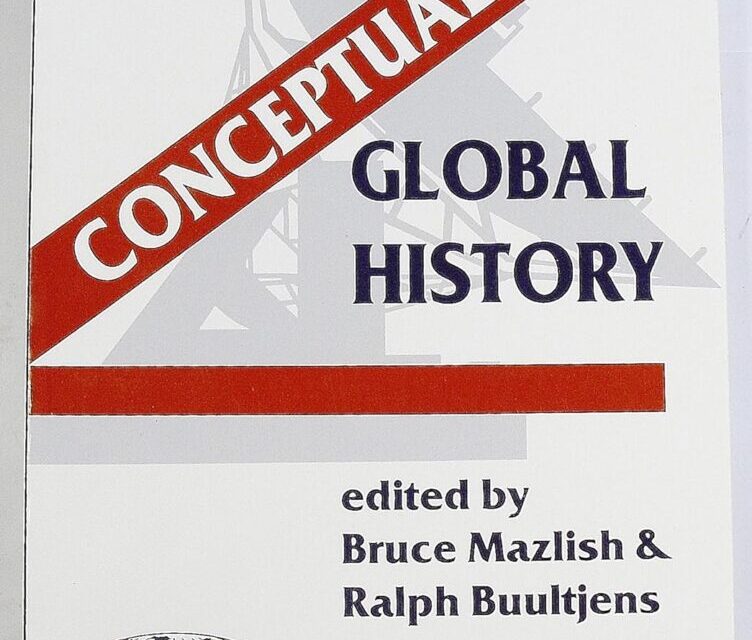
Dès 1989, Bruce Mazlish a réuni un petit groupe d’universitaires autour d’un projet de grande ampleur : la New Global History Initiative. Le groupe publie un ouvrage collectif : Conceptualizing Global History (Westview Press, 1993). Pour Bruce Mazlish qui rédige l’introduction de l’ouvrage, il est urgent d’abandonner les points de vue nationaux, régionaux ou locaux. Les historiens ont déjà perçu les traces d’un mouvement qui dépasse les frontières du Vieux Continent au XVe siècle, au XVIe siècle et au XIXe siècle. A la fin du XXe siècle, le même mouvement s’accélère. La mondialisation, puisque c’est de cela dont il s’agit, n’est donc pas un phénomène nouveau ; elle possède au contraire des traces dans le passé que le rôle des historiens est de mettre en évidence. Mais la mondialisation contemporaine s’accompagne d’un phénomène qui était inconnu des époques précédentes et qui doit donc engager une nouvelle réflexion sur le monde. La course à l’espace, l’envoi de satellites en orbite autour de la Terre, la « Destruction Mutuelle Assurée » par le risque nucléaire au cours de la guerre froide, les problèmes environnementaux, sont les signes d’une véritable représentation de la Terre comme d’un Monde partagé. Il faut favoriser une nouvelle perspective scientifique, une nouvelle conscience historique et un nouveau sous-domaine de l’histoire. La New Global History Initiative s’attache donc à mettre en évidence cette représentation présente de la « communauté globale » 3. Elle n’est donc ni eurocentrée, ni concentrée sur les frontières des Etats-nations, ni téléologique. En revanche, elle est positivement à la fois narrative et analytique, et doit, pour être efficace, être une science qui associe plusieurs disciplines entre elles.
« An Introduction to Global History » est un manifeste en faveur de la Global History, par opposition à la World History. Bruce Mazlish propose donc de passer de la World History à la Global History et définit l’objet de la Global History comme l’analyse de la naissance et de l’évolution de la « globalisation » plutôt que de la « mondialisation ». depuis les années 1970 ; avant cela, il n’y a qu’une « mondialisation ». Ce qui est dès lors intéressant, ce n’est pas la narration d’une histoire commune, partagée, synthétique et peu crédible de l’Humanité dans son ensemble : c’est le réseau de connexions qui relie un événement à des conséquences extérieures.
Dans The New Global History (Routledge, 2006) et Globalization and Transformation (Routledge, 2015), Bruce Mazlish fait le point sur l’évolution du monde depuis l’écriture du manifeste de la New Global History Initiative. Il s’appuie sur les réflexions d’Anthony Gerald Hopkins au début du siècle (Globalization in World History, Norton, 2002) et sur la définition que le grand historien britannique donne de la « globalisation » dans Global History : Interactions Between the Universal and the Local (MacMillan, 2006) : « globalization involves the extension, intensification and quickening velocity of flows of people, products and ideas that shape the world. It integrates regionds and continents ; it compresses time and space ; it prompts imitation and resistance. The result alter and may even transform relationships within and among states and societies across the globe ». Il s’appuie également sur les propositions de Peter Stearns dans Globalization in World History (Routledge, 2009) qui définit la globalisation comme « the process of transformation of local phenomena into global ones … a process by which the people of the world are unified into a single society and function together. This process is a combination of economic, technological, sociocultural and political forces, though globalization terminology is often used to focus primarily on economics – the integration of national economies into an international economy through trade, foreign direct investment, capital flows, migration, and the spread of technology ».
A la suite d’Anthony Gerald Hopkins et de Peter Stearns, Bruce Mazlish promeut donc une Nouvelle Histoire Globale. Il écrit que « in its simplest form, it is a theory about social relations, emphasizing that those relations, whatever their specific form, are becoming more widespread, with the parties to them more and more interconnected and interdependent in various ways. There is always a geographical dimension to this development as greater expansion into the world takes place ». L’évolution de l’Histoire au tournant des XXe et XXIe siècles démontre que le monde (d’abord bipolaire, puis unipolaire et à présent multipolaire), les civilisations et les structures ne fournissent plus une échelle d’analyse valide ; ce qui compte désormais, ce sont les connexions globales. Pour Bruce Mazlish, la Global History serait la meilleure manière d’étudier le monde de plus en plus interdépendant et interconnecté, et d’analyser la société forcément globalisée qui en est née.
Cependant, contrairement à d’autres historiens, Bruce Mazlish ne limite ni la modernisation ni la globalisation aux développements du capitalisme et des échanges économiques. Il énumère plusieurs « facteurs de globalisation » qui illustrent aussi bien les causes que les effets de l’interdépendance et de l’interconnectivité entre les sociétés. Selon lui, la décolonisation a engendré un éclatement spatial des centres de la planète, alors que la mondialisation économique a produit des possibilités d’influence élargie des firmes transnationales et des organisations non-gouvernementales. Il ajoute à ces trois facteurs le développement des communications, la simplification des migrations, la diffusion des cultures et des religions par internet, les progrès technologiques ou encore le renforcement des phénomènes diasporiques, pour mettre en évidence la connectedness du monde global.

Vous souhaitez lire la suite ?
Actifs dans le débat public sur l'enseignement de nos disciplines et de nos pratiques pédagogiques, nous cherchons à proposer des services multiples, à commencer par une maintenance professionnelle de nos sites. Votre cotisation est là pour nous permettre de fonctionner et nous vous en remercions.
Notes
- Charles Maier (dir), The Shock of the Global : the 1970s in Perspective, Harvard University Press, 2010. Parmi les auteurs ayant « anticipé » la révolution de la globalisation, nous pouvons citer Roland Robertson, Carl Becker, Kenneth Cooper, Richard Bulliet, Pamela Crossley.
- « A conviction that time and space have been compressed in an unprecedented fashion. The roots of this compression reach far into the past. The development of sea vessels, from sail to steam, cutting distance and duration, forms one thread in this account. The invention of the telegraph, the laying of cables, the introduction of the telephone, and then of radio communication represent another wave of enormous changes. Now, satellites, with the aid of computer linkages, allow simultaneous communication between any spots on the globe – 1 billion people watched the first step on the moon on their television sets – and they can go from one end of the globe to the other in less than a day […]. Another major thread to follow is mapping […]. The emergence of globalization was not simply a matter of science, technology, and economics ; political developments were also requisite. First, the competition between the Soviet Union and the United States in space was essential for the creation of our increasingly satellite-dependent world, with its attendant communications revolution. Furthermore, the decline of commu-nism eroded the old political-ideological divisions, leaving the way open for a genuinely global society, in which all countries can and must participate, though differentially… » (Bruce Mazlish, « Comparing Global History to World History », Journal of Interdisciplinary History, 28, 1998, p. 385-395, p. 391-392.
- « Global history is contemporary history. In the eyes of some historians, contemporary history is not history at all ; they feel that the lack of a long-term, traditional perspective precludes the possibility. Yet Herodotus started with a contpmporary event, the Persian-Athenian War, and wrote a « history, » i.e., an « inquiry » into the events surrounding him. that is generally recognized as the beginning of the discipline. His record and analysis then became the basis of « Greek history, » as studied by subséquent scholars. One might also argue that, whether acknowledged or not, all history is contemporary history in the sense that the perspective brought to bear on past events is necessarily rooted in the présent. In this light, global history may simply be more conscious of its perspective and interested in focusing it more directly on contemporary happenings, as well as on the past » (Bruce Mazlish, « An introduction to Global History », dans Bruce Mazlish et Ralph Buultjens (dir), Conceptualizing Global History, Westview Press, 1993, p. 1-24, p. 2-3.
- Paul Krugman, Geography and Trade, MIT Press, 1991.
- Denis Chartier, Estienne Rodary (dir), Manifeste pour une géographie environnementale, Presses de Sciences Po, 2016.
- « At the end of the twentieth century, we encounter, not a universalizing and single modernity but an integrated world of multiple and multiplying modernities. As far as world history is concerned, there is no universalizing spirit, no Weltgeist, to be re/presented working its way out in history. There are, instead, many very specific, very material and pragmatic practices that await critical reflection and historical study. At the same time, there is no particular knowledge to be generalized or built up from these discrete practices into a general theory or global paradigm. Rather, there is general and global knowledge, actually in operation, that requires particularization to the local and human scale. Funda mentally, then, our basic strategies of historical narration have to be rethought in order to make sense of practices and processes of global integration and local differentiation that have come into play » (Michael Geyer et Charles Bright (« World History in a Global Age », The American Historical Review, 100, 1995, p. 1034-1060, p. 1035).
- Christopher Chase-Dunn, Yukio Kawano, Benjamin Brewer, « Trade Globalization Since 1795 : Waves of Integration in the World-System », The American Sociological Review, 65, 2000, p. 77-95.
- Christopher Chase-Dunn, Yukio Kawano, Benjamin Brewer, « Trade Globalization Since 1795 : Waves of Integration in the World-System », The American Sociological Review, 65, 2000, p. 77-95.
- « We can determine by dividing the definition of global history into two parts. The first focuses on the history of globalization ; that is, it takes existing processes, encapsulated in the « factors of globalization, » and traces them as far back in the past as seems necessary and useful. The second signifies processes that are best studied on a global, rather than a local, a national, or a regional, level. The second definition is a continuation of much that is to be encountered in McNeill’s variation of world history, except that it begins in the present, openly acknowledging its informed global perspective. The first part of the definition – the history of globalization – is both the heart and the novelty of global history, deciding the initial field of study and raising the questions, What is involved in globalization ? and What are the factors at work in our con-temporary « world » ? […]. The practitioners of global history include adherents of both a strong and a weak interpretation. The former are convinced that globalization is ushering in a new global epoch, which replaces existing attempts to contruct such periods as the postmodern or the postindustrial. The adherents of the weak interpretation abstain from divisionary schemes, and are content to study the globalization process without further claims. For those who see globalization as introducing a new period, the issue of when the global epoch « began » is worth considerable attention (analogous to the issue of when modern history began). Some opt for the 1950s and others for the I970s (I place myself in the epochal camp, and opt for the later time) » (Bruce Mazlish, « Comparing Global History to World History », Journal of Interdisciplinary History, 28, 1998, p. 385-395, p. 389-391.
- Bruce Mazlish, « Ecumenical, World, and Global History », dans Philip Pomper, Richard Elphick, Richard Vann (dir), World History. Ideologies, Structures and Identities, Blackwell, 1998, p. 41-52, p. 49.
- Bruce Mazlish, « An Introduction to Global History », dans Bruce Mazlish et Ralph Buultjens (dir), Conceptualizing Global History, Westview Press, 1993, p. 1-24.
- Bruce Mazlish s’appuie à la fois sur les travaux de Jürgen Habermas et sur ceux de Mary Kaldor pour démontrer que la globalisation pourrait conduire à court terme à l’émergence d’une société civile globale. Il cite en particulier Mary Kaldor, Helmut Anheier, and Marlies Glasius (dir), Global Civil Society 2001, Oxford University Press, 2001 et Mary Kaldor, Helmut Anheier, and Marlies Glasius (dir), Global Civil Society 2003, Oxford University Press, 2003.
- Benedict Anderson, Imagined Communities : Reflections on the Origin and Spread of Nationalism, Verso, 1983. Si Benedict Anderson invente ce concept pour désigner les nations comme des communautés socialement construites, l’application de ce même concept à l’humanité, c’est-à-dire à une organisation supranationale, peut faire débat. Elle représente à la fois une illumination bienvenue (l’humanité est une construction sociale) et une invraisemblance (l’humanité est un groupe naturel qui préexiste aux communautés nationales).
- Kwame Anthony Appiah, Cosmopolitanism : Ethics in a World of Strangers, Norton, 2006 ; Bruce Robbins, Secular Vocations, Verso, 1993.
- Akira Iriye, « Globalization as Americanization ? », dans Bruce Mazlish (dir), The Paradox of a Global USA, Stanford University Press, 2007, p. 31-48.
- James Womack (dir), The Machine That Changed the World (Rawson Associates, 1990 ; Joseph Grunwald, Kenneth Flamm, The Global Factory : Foreign Assembly and International Trade, Brookings, 1985 ; Paul Knox and John Agnew, The Geography of the World Economy, Edward Arnold, 1989 ; Robert Reich, The Work of Nations, Alfred Knopf, 1991 ; Michael Porter, The Competitive Advantage of Nations, Free Press, 1990 ; Paul Krugman, Geography and Trade, Leuven University Press, 1991 ; Richard Barnet, John Cavanagh, « A Globalizing Economy : Some Implications and Consequences », dans Bruce Mazlish et Ralph Buultjens (dir), Conceptualizing Global History, Westview Press, 1993, p. 153-171 ; Paul Krugman, International Trade : Theory and Policy, Springer, 1998.
- Alain Joxe, « L’empire global et ses guerres locales », Hérodote, 108, 2003, p. 145-163 ; « Les Etats-Unis et le reste du monde », numéro spécial d’Hérodote, 109, 2003 ; Eric Hobsbawm, « Où va l’empire américain ? », Le Monde Diplomatique, juin 2003. Voir aussi, plus récemment, Emmanuel Todd, Après l’empire. Essai sur la décomposition du système américain, Gallimard, 2022.
- James Kurth, « Globalization and Empire : the Effects of 9/11 and the Iraq War », dans Bruce Mazlish (dir), The Paradox of a Global USA, Stanford University Press, 2007, p. 149-172.
- Peter Gowan, The Global Gamble : Washington’s Faustian Bid for World Dominance, Verso, 1999.
- David Reynolds, « Expansion and Integration : Reflections on the History of America’s Approach to Globalization », dans Bruce Mazlish (dir), The Paradox of a Global USA, Stanford University Press, 2007, p. 49-63. L’historien décrit la globalisation américaine depuis le XIXe siècle comme un processus d’« expansion par intégration » : le monde se divise en deux, les alliés et les ennemis. Pour protéger la paix, il faut intégrer les ennemis en changeant leur système politique et culturel, en les calquant sur le modèle et les valeurs que l’on veut protéger (les deux meilleurs exemples étant le Chili sous la dictature de Pinochet et l’Irak post-Saddam Hussein).
- Akira Iriye, « Globalization as Americanization ? », dans Bruce Mazlish (dir), The Paradox of a Global USA, Stanford University Press, 2007, p. 31-48.
- James Kurth, « First War of the Global Era : Kosovo and U.S. Grand Strategy » dans Andrew Bacevich, Eliot Cohen (dir), War over Kosovo : Politics and Strategy in a Global Age, Columbia University Press, 2001), p. 63-96 ; James Kurth, « Confronting the Unipolar Moment : the American Empire and Islamic Terrorism », Current History, 2002, p. 403-407.
- Ces conceptions se fondent sur la théorie de la « fin de l’histoire » de Francis Fukuyama (1990) : la fin de la guerre froide marquerait la victoire idéologique de la démocratie et du libéralisme. Les Etats-Unis n’ayant plus aucun ennemi dans le monde, ils sont les vainqueurs et dominent les relations internationales, marquant ainsi la « fin de l’histoire ».
- Voir Andrew Bacevich, The American Empire : the Realities and Consequences of U.S. Diplomacy, Harvard University Press, 2002 ; « An American Empire ? », numéro spécial de The Wilson Quarterly, 26, 2002 ; Andrew Bacevich (dir), The Imperial Tense : Prospects and Problems of American Empire, Ivan R. Dee, 2003.
- La prison de haute sécurité de de Guantanamo, dans le sud-est de Cuba, est ouverte en 2001, après les attentats. Les détenus sont des « combattants illégaux » capturés par l’Armée américaine à l’étranger et envoyés ici plutôt qu’aux Etats-Unis, afin qu’ils ne puissent pas être soumis au système judiciaire fédéral américain. L’ambiance de l’ère Bush se traduit aussi à travers le « héros » américain Jack Bauer dans la série 24 Heures chrono (2001-2010) produite par la chaîne conservatrice Fox.
- « The rhetoric is not mere hypocrisy. Those who mouth the words of democracy and international cooperation sincerely believe in them. The problem is that they are engaged in self-deception, for there is a disconnection between what is said and what is done. The giveaway, for example, is in the proclamation of the National Security Strategy of 2002, announcing that : ‘The U.S. national security strategy will be based on a distinctly American internationalism that reflects the union of our values and our national interests’. Translation : endowed with a heritage of exceptionalism, we will do what we wish, as the only superpower, resorting to international cover whenever possible. The corollary to this position is the elaboration of the doctrine of preemptive and preventive military action » (Bruce Mazlish, The New Global History, Routledge, 2006, p. 62).