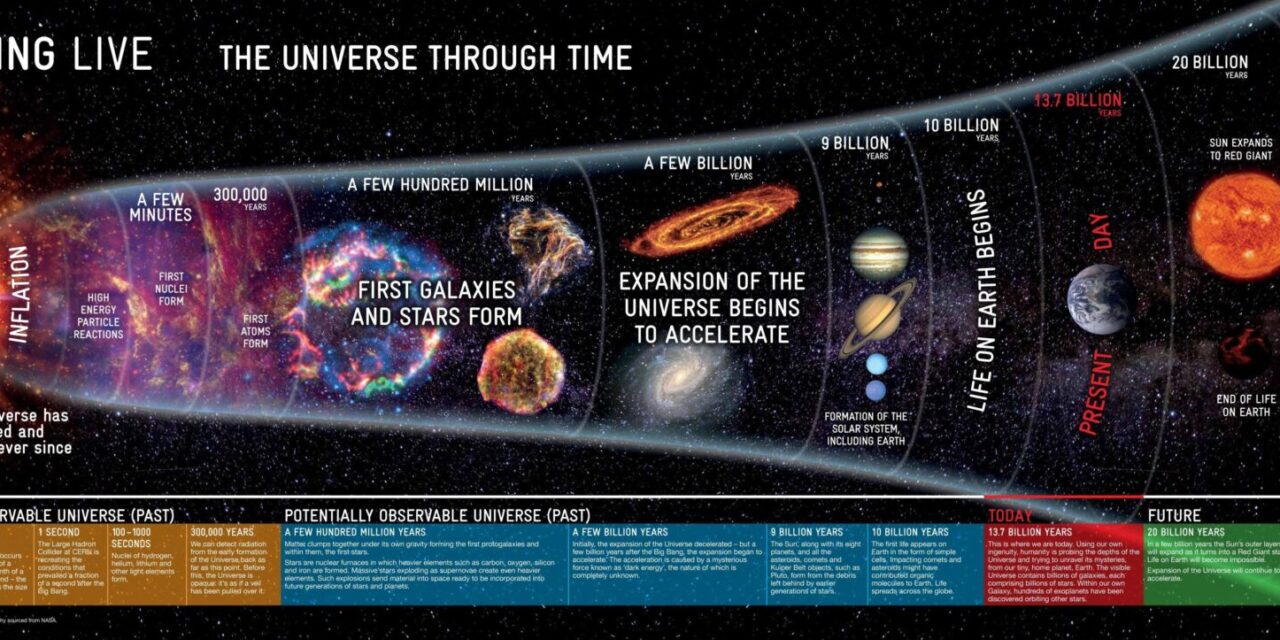
La Big History est une approche historique globale qui étudie l’histoire universelle dans l’espace et dans le temps, depuis l’origine du monde (le Big Bang) jusqu’à aujourd’hui. Elle intègre autant l’histoire que la cosmologie, les sciences humaines et les sciences dures. De cette manière, la vision du temps est entièrement modifiée. Celle de l’histoire environnementale l’est aussi.
Plan de la fiche
I. Une nouvelle histoire du temps
II. Les arguments en faveur d’une histoire depuis le Big Bang
III. Une autre approche de l’histoire environnementale
I. Une nouvelle histoire du temps
« The temporal scales of modern cosmology are as daunting as its spatial scales. Ever since Edwin Hubble showed, in the 1920’s, that the universe was expanding, it has seemed possible, in principle, to determine the age of the universe by estimating its rate of expansion. The details of this calculation are tricky, but today cosmologists are converging on an age of about 13 billion years. We cannot really grasp such colossal periods of time, but, with an imaginative effort, we can perhaps get some sense of their relationship to human history. The chronology in Table 1 collapses the timescales of modern cosmology by a factor of one billion. It reduces thirteen billion years to thirteen years, and picks out some of the dates within theses scales that are most significant for our own species.
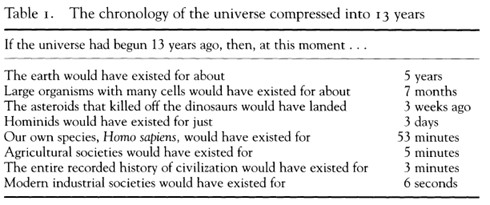
All in all, it may seem that our earth and our species have no significance at all within modern cosmology »1.
La Big History est apparue aux Pays-Bas dans les années 1980, puis en Australie et aux Etats-Unis à la fin du XXe siècle. Son meilleur défenseur est David Christian, qui a inventé le concept2.
Dans « The Case for ‘Big History’ » (Journal of World History, 2, 1991, p. 223-238), il est le premier à poser la question du renouvellement des échelles : « What is the scale on which history should be studied ? The establishment of the Journal of World History already implies a radical answer to that question : in geographical terms, the appropriate scale may be the whole of the world. In this paper, I will defend an equally radical answer to the temporal aspect of the same question : what is the time scale on which history should be studied ? ». Le Big Historian cherche à expliquer la longue évolution de l’expérience humaine. Il s’agit d’analyser les évolutions sociales planétaires sur la longue durée, de ne mettre en évidence que les « processus non programmés qui déclenchent un mouvement généralisé de décloisonnement des sociétés et d’unification sociale mondiale qu’on appelle mondialisation »3. La Big History unit l’histoire naturelle et l’histoire humaine dans une seule narration.
Selon David Christian, l’échelle de temps la plus appropriée est celle de la totalité du temps depuis la création de l’univers, c’est-à-dire il y a 13,8 milliards d’années. Ses préoccupations rejettent donc absolument la micro-histoire et la micro-histoire globale. L’histoire mondiale, malgré toute la nouveauté ce qu’elle apporte à l’échelle d’analyse, n’est pas non plus suffisante. Le temps de la vie humaine peine à être connecté à l’histoire de l’univers. La « longue durée » de Braudel est une réussite, mais elle est toute relative : elle ne remonte qu’à 60 000 ans. Ce dont l’Histoire a besoin, ce serait d’une compréhension beaucoup plus large, limitée seulement par la question des origines de l’univers. L’exploration du passé à une très grande échelle implique, pour l’historien, de se projeter en-dehors de tous les cadres et de toutes les conventions établies par la discipline.
II. Les arguments en faveur d’une histoire depuis le Big Bang
Bien avant Maps of Time (2005), David Christian défendait plusieurs arguments en faveur de la Big History.
Premièrement, l’histoire aura un impact puissant sur la pensée du public sur le passé parce qu’elle commencera à jouer un rôle similaire à celui des récits de création traditionnels : elle aspirera à créer une carte du passé dans son ensemble.

Vous souhaitez lire la suite ?
Actifs dans le débat public sur l'enseignement de nos disciplines et de nos pratiques pédagogiques, nous cherchons à proposer des services multiples, à commencer par une maintenance professionnelle de nos sites. Votre cotisation est là pour nous permettre de fonctionner et nous vous en remercions.
Notes
- David Christian, « World History in Context », Journal of World History, 14, 2003, p. 437-458, p. 439-440.
- David Christian est né aux Etats-Unis mais fait des études au Canada et en Angleterre. Ses premiers travaux portent sur l’histoire de la Russie. Puis, il donne un premier cours sur la Big History en 1989. En 2005, il publie Maps of Time : an Introduction to Big History, puis Big History : Between Nothing and Everything en 2014 et Origin Story : a Big History of Everything en 2018. David Christian est également président de l’International Big History Association fondée en avril 2011.
- René-Eric Dagorn, « Big History et histoire environnementale », dans Laurent Testot (dir), Histoire globale. Un autre regard sur le monde, Editions Sciences Humaines, 2015, p. 196-205, p. 199. Dans « The Case for ‘Big History’ » (Journal of World History, 2, 1991, p. 223-238), David Christian prend plusieurs exemples et démontre que les échelles de temps utilisées par les historiens ne sont pas les plus pertinentes : la question de la croissance économique et démographique ne doit pas être étudiée depuis les premières sociétés urbanisées il y a 5000 ans mais depuis l’apparition de l’Homo Sapiens il y a 250 000 ans. D’autre part, ces questionnements à grande échelle permettent aussi de s’interroger sur l’avenir de la planète et de l’univers, notamment en termes d’équilibre climatique et énergétique, sous l’ère de l’Anthropocène.
- Barbara Weinstein, « History without a Cause ? Grand Narratives, World History, and the Postcolonial Dilemma », International Review of Social History, 50, 2005, p. 71-93 ; David Christian, « The Return of Universal History », History and Theory, 49, 2010, p. 6-27 ; Gérald Sfez, Logiques du vif, L’Harmattan, 2016 (chapitre 2 : la raison postmoderne, p. 59-114).
- Dans l’introduction de Origin Story. A Big History of Everything (Penguin, 2012), David Christian décrit assez bien la tradition des mythes des origines : « In my imagined twilight conversations around the fire, there are girls and boys, older men and women, and parents and grandparents, some wrapped in animal furs and cradling babies. Children are chasing one another at the edge of the lake while adults are finishing a meal of mussels, freshly caught fish and yabbies, and wallaby steak. Slowly, the conversation becomes serious and is taken over by one of the older people. As on many long summer days and cold winter nights, the older people are retelling what they have learned from their ancestors and teachers. They are asking the sort of questions that have always fascinated me : How did the landscape, with its hills and lakes, its valleys and ravines, take shape ? Where do the stars come from? When did the first humans live, and where did they come from ? Or have we always been here ? Are we related to goannas and wallabies and emus ? (The answer of both the Lake Mungo people and modern science to that last question is a decisive “Yes !”) The storytellers are teaching history. They are telling stories about how our world was created by powerful forces and beings in the distant past. Told over many nights and days, their stories describe the big paradigm ideas of the Lake Mungo people. These are the ideas with long legs, the ideas that can stay the course. They fit together to form a vast mosaic of information about the world. Some of the children may find parts of the stories too complex and subtle to take in at first hearing. But they hear the stories many times in different tellings, and they get used to them and to the deep ideas inside the stories. As the children get older, the stories get under their skin. They come to know them intimately and better appreciate their beauty and their subtler details and meanings. As they talk about the stars, the landscape, the wombats and the wallabies, and the world of their ancestors, the teachers build a shared map of understanding that shows members of the community their place in a rich, beautiful, and sometimes terrifying universe : This is what you are ; this is where you came from; this is who existed before you were born; this is the whole thing of which you are a small part ; these are the responsibilities and challenges of living in a community of others like yourself. The stories have great power because they are trusted. They feel true because they are based on the best knowledge passed down by ancestors over many generations. They have been checked and rechecked for accuracy, plausibility, and coherence using the rich knowledge of people, of stars, of landscapes, of plants and animals available to the Mungo community and to their ancestors and neighbors. We can all benefit from the maps our ancestors created […]. Without them, people could fall into a sens of despair and meaningless so profound, it might drive them to suicide » (p. 13-15).
- « Collective learning ensures that human history, unlike that of other species, is a process of accumulation and acceleration, and it is this process of cumulative and accelerating adaptation to the natural environment that is traced in world history. All in all, collective learning is so powerful and adaptive mechanism that there is a case for arguing that it plays an analogous role in human history to that of natural selection in the histories of other organisms » (David Christian, « World History in Context », Journal of World History, 14, 2003, p. 437-458, p. 446) ; « How can we explain this remarkable capacity for sustained and accelerating adaptation that seems to be a new emergent property of our species and the primary driver of change in human history? I have argued elsewhere that the key is the remarkable precision and fluency of human language, which allowed humans alone to share learned knowledge so precisely and in such volume that it could accumulate with minimal degradation within the memory banks of entire communities. Human language linked humans into highly efficient information networks through which the learning of each individual could be shared, added to, and passed on to future generations. The slow mechanism of genetic inheritance was overlaid by the much faster mechanism of knowledge transfer. The long-term trends that make human history so different are driven, in other words, by a new and more rapid adaptive mechanism that we can call ‘collective learning’ » (David Christian, « The Return of Universal History », History and Theory, 9, 2010, p. 6-27, p. 24) ; « Collective learning is what gives humans a history, because it means that the ecological skills available to humans have changed over time. And there is a clear directionality to this process. Over time, processes of collective learning ensure that humans as a species will get better at extracting resources from the environment, and their increasing ecological skills ensure that, over time, human populations will increase. Generalizations about collective learning cannot predict the exact timing or geography of such processes, of course, nor how far they are likely to proceed, nor their detailed consequences; but such generalizations can tell us something about the long-term shape of human history on large timescales. To get a feeling for the power of collective learning, it is enough to imagine life as it might be if we had to learn everything from scratch, receiving little more from family or community than hints about appropriate social behavior and eating habits, which is more or less the intellectual heritage of young chimps. How many of the artifacts around us (each of which embodies stored knowledge) could we invent or construct in a lifetime ? Asking such questions is a powerful reminder of the extraordinary extent to which our lives as individuals depend on the accumulated knowledge of millions of other humans over many generations. Humans as individuals are not that much cleverer than chimps or Neanderthals; but as a species we are vastly more creative because our knowledge is shared within and between generations. All in all, collective learning is so powerful an adaptive mechanism that one might argue it plays a role in human history analogous to that of natural selection in the histories of other organisms » (David Christian, Maps of Time : an Introduction to Big History, University of California Press, 2005 p. 147).
- Voir par exemple Alfred Crosby, The Columbian Exchange : Biological and Cultural Consequences of 1492, Greenwood Press, 1972 ; John Gribbin, Genesis : the Origins of Man and the Universe, Delacrote Press, 1981 ; Alfred Crosby, The Biological Exoansion of Europe, 900-1900, Cambridge University Oress, 1986 ; Brian Fagan, The Journey From Eden : the Peopling of our World, Thames and Hudson, 1990 ; B. L. Turner II, William Clark, Robert Kates, John Richards, Jessica T. Mathews, William Meyer (dir), The Earth as Transformed by Human Action. Global and Regional Changes in the Biosphere over the Past 500 Years, Cambridge University Press, 1990 ; John McNeill, « Of Rats and Men : a Synoptic Environmental History of the Island Pacific », Journal of World History, 5, 1994, p. 299-349 ; Ben Finney, « The Other One-Third of the Globe », Journal of World History, 5, 1994, p. 273-297 ; Stephen Sanderson, Social Transformations : a General Theory of Historical Development, Blackwell, 1995 ; Clive Gamble, Timewalkers, Penguin, 1995 ; Fred Spier, The Structure of Big History : From the Big Bang until Today, Amsterdam University Press, 1996 ; David Keys, Catastrophe : an Investigation into the Origins of Modern Civilization, Century, 1999 ; I. G. Simmons, Changing the Face of the Earth : Culture, Environment, History, Blackwell, 1996 ; Jared Diamond, Guns, Germs, and Steel : the Fates of Human Societies, Norton, 1997 ; John McNeill, Something New Under the Sun : an Environmental History of the Twentieth-Century World, Norton, 2000 ; Andrew Goodie, The Human Impact on the Natural Environment, Blackwell, 2000 ; Jean Baechler, Esquisse d’une histoire universelle, Fayard, 2002 ; Steven Mithen, After the Ice : a Global Human History, Orion Books, 2003 ; B. de Vrie, Johan Goudsblom (dir), Mappae Mundi : Humans ant their Habitats in a Long-Term Socio-Ecological Perspective, Amsterdam University Press, 2002 ; Jared Diamond, Collapses : How Societies Choose to Fail or Succeed, Viking Press, 2005 ; Charles Mann, 1491 : New Revelations of the Americas Before Columbus, Vintage Book, 2005 ; Alf Hornborg, Carole L. Crumley, The World System and the Earth System, Global Socioenvironmental Change and Sustainability Since the Neolithic, Routledge, 2006 ; Sing Chew, « Dark Ages : Ecological Crisis Phases and System Transition », dans Barry Gills, William Thompson (dir), Globalization and Global History, Routledge, 2006, p. 149-183 ; Cynthia Stokes Brown, Big History From the Big Bang to the Present, New Press, 2007 ; Christian Grataloup, Géohistoire de la mondialisation, Armand Colin, 2007 ; Alf Hornborg, Alier Martínez, John McNeill, John Robert, Immanuel Wallerstein, Rethinking Environmental History, World-System History and Global Environmental History, Altamira Press, 2007 ; Edmund Burke III, Kenneth Pomeranz (dir), The Environment and World History, University of California Press, 2009 ; Fred Spier, Big History and the Future of Humanity, Wiley-Blackwell, 2010 ; Yuval Noah Harari, Sapiens: A Brief History of Humankind, 2011; Laurent Testot, Cataclysmes : une histoire environnementale de l’humanité, Payot, 2017.
- Paul Crutzen, Eugene Stoermer, « The Anthropocene », International Geosphere-Biosphere Programme Newsletter, 41, 2000 ; Paul Crutzen, « Geology of Mankind », Nature, 3 janvier 2002. Voir aussi Will Stephen, Paul Crutzen, John McNeill, « The Anthropocene : Are Humans Now Overwhelming the Great Forces of Nature ? », Ambio, 36, 2007, p. 614-621 ; David Christian, « The Anthropocene », Berkshire Encyclopedia of World History, Berkshire Publishing, 2010 ; Stefen Will, Wendy Broadgate, Lisa Deutsch, Owen Gaffney, Cornelia Ludwig, « The trajectory of the Anthropocene : the Great Acceleration », The Anthropocene Review, 2015, p. 1-18.
- Florence Prévost, « Le retour de l’histoire universelle : une façon de changer le rapport au conflit ? », Conflits et sociétés, 34, 2017, p. 219-234, p. 227.
- « I predict that in fifty years’ time, all historians will understand that it is possible and fruitful to explore the past on multiple scales, many extending far beyond Braudel’s longue durée, by reaching back to the origins of our species, the origins of the earth, and even the origins of the cosmos. The new universal history will transcend existing disciplinary boundaries, exploiting the powerful intellectual synergies available to those willing to deploy the methods and insights of multiple disciplines » (« The Return of Universal History », History and Theory, 49, 2010, p. 6-27, p. 7).
- « At the end of the twentieth century, we encounter, not a universalizing and single modernity but an integrated world of multiple and multiplying modernities. As far as world history is concerned, there is no universalizing spirit, no Weltgeist, to be re/presented working its way out in history. There are, instead, many very specific, very material and pragmatic practices that await critical reflection and historical study. At the same time, there is no particular knowledge to be generalized or built up from these discrete practices into a general theory or global paradigm […]. We confront a startling new condition : humanity, which has been the subject of world history for many centuries and civilizations, has now come into the purview of all human beings. This humanity is extremely polarized into rich and poor, powerful and powerless, vociferous and speechless, believers and non-believers » (Michael Geyer, Charles Bright, « World History in a Global Age », American Historical Review, 100, 1995, p. 1034-1060, p. 1058-1059).