Cette fiche historiographique porte sur la naissance et à la généalogie de l’Atlantic History dans le monde anglo-saxon, mais aussi en France. Il s’agit de l’une des plus anciennes formes de l’histoire global, avant la naissance de la Global History dans les années 1990. Elle a été écrite à partir des notes de nombreuses lectures sur le sujet, qui se trouvent ajoutées en note en bas de page.
Cette fiche s’intéresse au développement de l’Atlantic History. Ici, c’est la première phase qui est traitée: celle du White Atlantic (des années 1940 au début des années 1970).
PLAN
I. La généalogie de l’Atlantic History
II. La construction du programme de l’Atlantic History dans les années 1970 au contact des Cultural Studies
I. La généalogie de l’Atlantic History
Il est possible de schématiser la généalogie de l’histoire atlantique en trois étapes successives :
- les travaux se focalisant sur le White Atlantic à partir des années 1940 et 1950 ;
- le développement des études sur la traite, l’esclavage, la diaspora noire et le Black Atlantic à partir des années 1970 ;
- la synthèse et les efforts de conceptualisation de ces différentes histoires, qui sont à l’origine de la « nouvelle » histoire atlantique depuis le milieu des années 1990, et qui continue d’évoluer de nos jours.
Les premières conceptions d’un monde atlantique se limitent à un Atlantique à la fois racialisé et occidentalisé. Déjà, entre les deux guerres mondiales, le journaliste américain Walter Lippmann évoquait une « communauté atlantique » qui unirait l’Amérique du Nord, l’Amérique latine et l’Europe occidentale. Son intention était de rompre avec l’isolationnisme américain dominé par la Doctrine Monroe (1823). A partir de la rédaction de la Charte de l’Atlantique en 1941, Lippmann se fait l’un des plus grands défenseurs de l’atlanticisme entre toutes les rives de l’océan1.
Le monde atlantique a été constitué bien plus tôt, mais en-dehors de quelques travaux mineurs (W. E. B. Du Bois, C. L. R. James, Eric Williams, Walter Lippman), les historiens n’ont jamais pris la mesure d’un « système » ou d’une « communauté » atlantique avant le milieu du XXe siècle. Ce n’est qu’à partir de la Seconde Guerre mondiale que le concept de « monde atlantique » désigne, dans une acception géopolitique, la communauté atlantique libérale et démocratique, ainsi qu’une entité historique au sein des diplomaties du camp opposé aux Nazis2.
Pour les historiens, le courant particulier de l’histoire atlantique est né des réflexions (en français) de Jacques Godechot et Robert Palmer, Jacques Pirenne, Frédéric Mauro, Charles Verlinden, Pierre et Huguette Chaunu, et Vittorino Magalhes-Godinho3, réflexions motivées par la mise en place l’OTAN en 1949. Il n’y a donc rien d’étonnant à ce que les travaux sur la « communauté atlantique » en France comme en Grande-Bretagne accordent un rôle central aux Etats-Unis. Mais l’histoire atlantique anglo-saxonne sait aussi prendre ses distances par rapport à cette première approche très justement qualifiée d’« atlantiste » ou « atlanticiste ».
Les travaux initiaux, dans les années 1950-1960, analysaient de manière quantitative le trafic commercial entre une métropole et ses colonies, recherchaient les structures et les conjonctures de l’espace atlantique, étudiaient les influences intellectuelles, politiques et culturelles entre l’Europe et les colonies, comparaient les révolutions françaises et américaines. Les concepts d’« économie atlantique » (Huguette et Pierre Chaunu), de « monde atlantique » (Vittorino Magalhes-Godinho), d’« espace atlantique » (Lucien Febvre), de « structures et conjonctures de l’espace atlantique » (Pierre Chaunu), de « révolutions atlantiques » (Jacques Godechot) se sont ainsi diffués au sein du courant des Annales.
Les approches culturelles de l’histoire atlantique n’ont été mises en place qu’après ces études économiques. Vingt ans plus tard, aux Etats-Unis, l’influence totalisante dépistée l’historiographie française a enfin croisé celle du Cambridge Group for the History of Population and Social Structure (qui doit beaucoup au développement de la sociologie et de l’anthropologie structuraliste) pour développer une autre approche de l’histoire atlantique, moins politique et constitutionnelle.
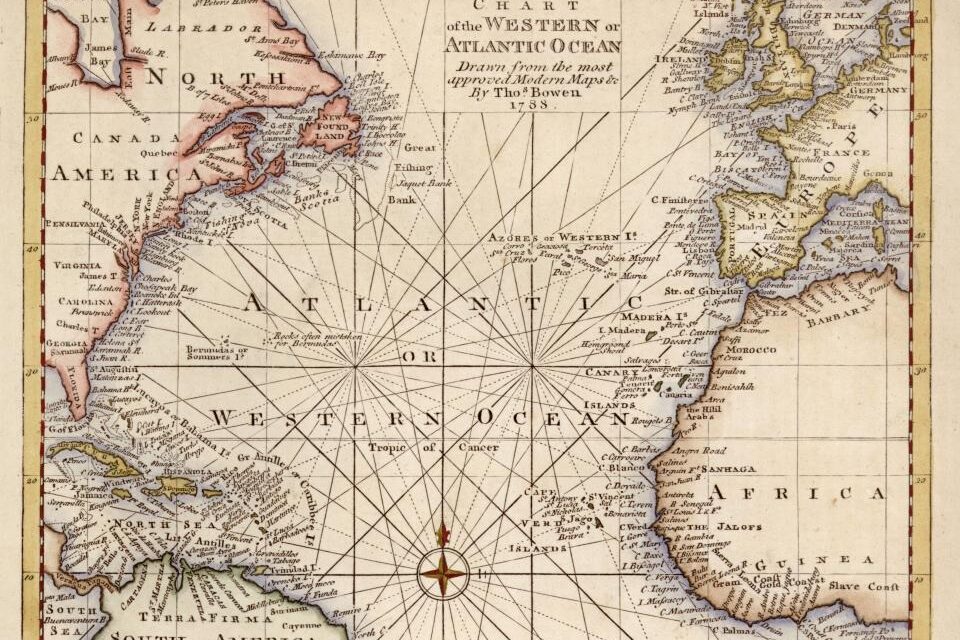
Au cours de ces transformations de la première à la deuxième phase de l’histoire atlantique, l’une des questions les plus débattues a été celle de la définition géographique de « l’espace atlantique ». Pendant la majeure partie du second XXe siècle, les chercheurs ont considéré, à la suite de Walter Lippman (1917, puis 1941), qu’il s’agissait de l’espace qui partageait les caractéristiques diffusées par les colons européens. Les populations atlantiques partageaient :
« 1) a movement of traffic and commodities across imperial boundaries, which led to a previously unseen diffusion of capital and finance. In turn this led, to improved communication, which had consequential effects on intellectual, cultural, and political change and exchange ; 2) a monumental movement of free and un-free migrants over a five hundred year period that radically altered or destroyed many cultures and radically, and detrimentally, transformed many others ; 3) a use and modification of labor forms, most importantly of slave and indentured forms of labor ; 4) and a sharing or borrowing of commercially and economically-informed social, legal and political ideas across imperial boundaries which led directly and indirectly to new forms of territorial government and political practices »4.
Il s’agissait donc uniquement d’un White Atlantic, défini par l’Etat-nation, le capitalisme impérial et colonial, et la supériorité de la culture européenne.

Vous souhaitez lire la suite ?
Actifs dans le débat public sur l'enseignement de nos disciplines et de nos pratiques pédagogiques, nous cherchons à proposer des services multiples, à commencer par une maintenance professionnelle de nos sites. Votre cotisation est là pour nous permettre de fonctionner et nous vous en remercions.
NOTES:
- Voir Bernard Bailyn, « The Idea of Atlantic History », Itinerario, 20, 1996, p. 19-44 ; David Armitage, « Three Concepts of Atlantic History », dans David Armitage et Michael J. Braddick (dir), The British Atlantic World, 1500-1800, New York, Palgrave Macmillan, 2002, p. 13-29 ; Nicholas Canny, « Atlantic History, 1492-1700 : Scope, Sources, and Methods », dans Horst Pietschmann (dir), History of the Atlantic History : History of the Atlantic System, 1580-1830, Vandenhoeck, 2002, p.55-64 ; Peter Coclanis, « Drang Nach Osten : Bernard Bailyn, the World-Island, and the Idea of Atlantic History », Journal of World History, 13, 2002, p. 169-182 ; William O’Reilly, « Genealogies of Atlantic History », Atlantic Studies, 1, 2004, p. 66-84 ; Donna Gabaccia, « A Long Atlantic in a Wider World », Atlantic Studies, 1, 2004, p. 1-27 ; Trevor Burnard, « Only Connect : the Rise (and Fall ?) of Atlantic History », Historically Speaking, 7, 2006, p. 19-21 ; Richard Blakemore, « The changing fortunes of Atlantic history », English Historical Review, 131, 2016, p. 851-868 ; David Armitage, « The Atlantic Ocean », dans David Armitage, Alison Bashford, Sujit Sivasundaram (dir), Oceanic Histories, Cambridge University Press, 2018, p. 85-110.
- Arnold Restad, Europe and the Atlantic World, 1941 ; Ross Hoffmann, « Europe and the Atlantic Community », Thought, 20, 1945, p. 25-34 ; Hale Bellot, « Atlantic History », History, 31, 1946, p. 56-63 ; Claude Delmas, Le monde atlantique, 1958 ; Robert Strausz-Hupé, James Dougherty, William Kintner, Building the Atlantic World, 1960.
- Jacques Godechot, Histoire de l’Atlantique, Paris, Bordas, 1947 ; Robert Palmer, « The World Revolution of the West, 1763-1801 », Political Science Quarterly, 69, 1954, p. 1-14 ; Jacques Godechot et Robert Palmer, « Le problème de l’Atlantique du XVIIIe au XXe siècle », dans Relazioni del X Congresso internazionale di Scienze storiche, Sansoni, 1955, p. 175-239 ; Jacques Godechot, Les Révolutions (1770-1792), Paris, PUF, 1963 ; Michael Kraus, The Atlantic Civilization. Eighteenth Century Origins, Cornell University Press, 1949 ; Robert Palmer, The Age of Democratic Revolution. A Political History of Europe and America, 1760-1800, Princeton University Press, 1959-1964 ; Charles Verlinden, « Les origines coloniales de la civilisation atlantique », Journal of World History, 1953, p. 378-398 ; Charles Verlinden, Les origines coloniales de la civilisation atlantique, de la Renaissance à l’âge des Lumières, Albin Michel, 1966 ; Huguette et Pierre Chaunu, « Économie atlantique, économie mondiale (1504-1650) », Cahiers d’histoire mondiale, vol. 2, 1953, p. 91-104 ; Huguette et Pierre Chaunu, Séville et l’Atlantique (1504-1650), Paris, Armand Colin, 1956-1959 ; Frédéric Mauro, Le Portugal et l’Atlantique au XVIIe siècle : étude économique, Paris, Armand Colin, 1960 ; Vittorino Magalhães-Godinho, « Création et dynamisme du monde atlantique, 1420-1670 », Annales ESC, 1950, p. 32-36 ; Vitorino Magalhães-Godinho, « Problèmes d’économie atlantique : le Portugal, flottes du sucre et flottes de l’or, 1670-1770 », Annales ESC, 1950, p. 184-197 ; Vitorino Magalhães-Godinho, L’économie de l’empire portugais aux XVe et XVIe siècles, Paris, SEVPEN, 1969.
- William O’Reilly, « Genealogies of Atlantic History », Atlantic Studies, 1, 2004, p. 66-84, p. 69.
- « A way of looking at global and regional processes within a contained unit, although that region was not, of course, hermetically sealed off from the rest of the world, and thus was simultaneously involved in transformations unique to the Atlantic and those derived from global processes. The Atlantic, moreover, is a geographic space that has a limited chronology as a logical unit of historical analysis : it is not a timeless unit : nor can this space fully explain all changes within it. Nonetheless, like other maritime regions, the Atlantic can offer a useful laboratory within which to examine regional and global transformations […]. Atlantic history is more than simply the study of a geographic unit : it is also a style of inquiry that reflects the impulse that drew historians in specific fields to Atlantic history in the first place. Within the space of these four centuries and these four continents, historians who adopt an Atlantic perspective explore commonalities and convergences, seeking larger patterns derived from the new interactions of people around, within, and across the Atlantic. The large geographic unit requires a different approach, one that by necessity deemphasizes any single place, although obviously some regions within and around the Atlantic enjoyed disproportionate political power at different points in time. If this is history without borders, then it should also be history without an imperial perspective […]. Atlantic history can offer a case study of the ways in which historians can break down not only old regional barriers and paradigms, but also modes of analysis based on modern cultural and political hierarchies. Atlantic history may deal with European dominion, but it should not be Eurocentric. It may cover a space dominated numerically by African migrants, but it need not be Afrocentric. The most dynamic changes of the period of contact may be most immediately evident in the Americas, but it should not be an expanded history of the colonial Americas. It requires a different kind of perspective, one ideally not fixe in any one location. Atlantic history poses paired challenges : linking several regions, in which no one historian can have the competence or expertise that scholars desire, and doing so through multiple perspectives », Alison Games, « Atlantic History : Definitions, Challenges, and Opportunities », American Historical Review, 111, 2006, p. 741-757, p. 748-750.
- Alison Games, « History Without Borders : Teaching American History in an Atlantic Context », Indiana Magazine of History, 91, 1995, p. 159-178.
- Par exemple Sidney Mintz et Richard Price, An Anthropological Approach to the Afro-American Past : A Caribbean Perspective, Philadelphia, Institute for the Study of Human Issues, 1976 ; Alan Karras et John McNeill (dir), Atlantic American Societies : From Columbus through Abolition, 1492 to 1888, Routledge, 1992 ; John Thornton, Africa and Africans in the Making of the Atlantic World, 1400-1680, Cambridge University Press, 1992 ; Paul Gilroy, The Black Atlantic : Modernity and Double Consciousness, Harvard University Press, 1993 ; Jacob Price, The Atlantic Frontier of the Thirteen Colonies and States, Ashgate, 1996 ; Paul Lovejoy, « The African Diaspora : Revisionist Interpretations of Ethnicity, Culture and Religion under Slavery », Studies in the World History of Slavery, Abolition and Emancipation, 2, 1997 (en ligne) ; Philip Morgan, « The Cultural Implications of the Atlantic Slave Trade : African Regional Origins, American Destinations and New World Developments », Slavery and Abolition, 18, 1997, p. 122-145 ; Philip Morgan, Slave Counterpoint : Black Culture in the Eighteenth-Century Chesapeake & Lowcountry, Chapel Hill, University of North Carolina Press, 1998 ; « African and American Atlantic Worlds », numéro spécial de The William and Mary Quarterly, 56, April 1999 ; Robin Kelley « But a Local Phase of a World Problem’ : Black History’s Global Vision » Journal of American History, 86, 1999, 1045-77 ; Paul Lovejoy (dir), Identity in the Shadow of Slavery, Londres, Continuum, 2000 ; Kristin Mann, Edna Gay (dir), Rethinking the African Diaspora : the Making of a Black Atlantic World in the Bight of Benin and Brazil, Londres, Frank Cass, 2001 ; Isidore Okpewho, Carole Boyce Davies, Ali Mazrui (dir), The African Diaspora : African Origines and New World Identities, Indiana University Press, 2001 ; Patrick Manning, « Africa and the African Diaspora : New Directions of Study », Journal of African History, 44, 2003, p. 487-506 ; James Sweet, Recreating Africa : Culture, Kinship, and Religion in the African-Portuguese World, 1441-1770, Chapel Hill, University of North Carolina Press, 2003 ; Gwendolyn Hall, Slavery and African Ethnicities in the Americas: Restoring the Links, Chapel Hill, University of North Carolina Press, 2005.
- Par exemple Roger Bastide, African Civilisations of the New World, Londres, 1967 ; Ralph Davis, The Rise of the Atlantic Economies, Londres, Cornell University Press, 1973 ; Kenneth Davies, The North Atlantic World in the Seventeenth Century, Minneapolis, University of Minnesota Press, 1974 (4 volumes) ; Patrick K. O’Brien, « European Economic Development : The Contribution of the Periphery », Economic History Review, 35, 1982, p. 1-18 ; Peggy Liss, Atlantic Empires. The Network of Trade and Revolution, 1713-1826, Johns Hopkins University Press, 1983 ; John McCusker et Russell Menard, The Economy of British America, 1607- 1789, Chapel Hill, University of North Carolina Press, 1985 ; Ian Steele, The English Atlantic, 1675-1740 : An Exploration of Communication and Community, Oxford University Press, 1986 ; David Eltis, Economic Growth and the Ending of the Transatlantic Slave Trade, New York, 1987 ; David Eltis et Lawrence Jennings, « Trade between Western Africa and the Atlantic World in the Pre-Colonial Era », American Historical Review, 93, 1988, p. 936-959 ; Pieter Emmer, « European Expansion and Migration. The European Colonial Past and Intercontinental Migration : an Overview », Itinerario, 14, 1990, p. 11-24 ; Wolfgang Reinhard, « Economic Change in the Atlantic Triangle », dans Hans Pohl (dir), The European Discovery of the World and its Economic Effects on Pre-Industrial Society, 1500-1800, Stuttgart, Franz Steiner Verlag, 1990 ; Patrick O’Brien, « European Industrialisation from the Voyages of Discovery to the Industrial Revolution », dans Hans Pohl (dir), The European Discovery of the World and its Economic Effects on Pre-Industrial Society, 1500-1800, Stuttgart, Franz Steiner Verlag, 1990 ; David Harris Sacks, The Widening Gate : Bristol and the Atlantic Economy, 1450-1700, University of California Press, 1991 ; David Hancock, Citizens of the World : London Merchants and the Integration of the British Atlantic Community, 1735-1785, Cambridge University Press, 1995 ; Kevin O’Rourke et Jeffrey Williamson, « After Columbus. Explaining the Global Trade Boom, 1500-1800 », Journal of Economic History, 62, 2002, p. 417-456 ; Wolfgang Reinhard, La vieille Europe et les nouveaux mondes. Pour une histoire des relations atlantiques, Stuttgart, Jan Thorbecke Verlag, 2005 ; Elizabeth Mancke et Carole Shammas (dir), The Creation of the British Atlantic World, Baltimore, Johns Hopkins University Press, 2005 ; David Hancock, History of World Trade Since 1450, Macmillan, 2006 ; « The Intensification of Atlantic Maritime Trade (1492-1815) dans Christian Buchet et Gérard Le Bouëdec (dir), La mer dans l’histoire : la période moderne, Boydell and Brewer, 2017.
- Par exemple Paul Lovejoy, Transformations in Slavery. A History of Slavery in Africa, Cambridge, Cambridge University Press, 1983 ; David Richardson, « The Slave Trade, Sugar, and British Economic Growth, 1748-1776 », dans Barbara Solow et Stanley Engerman (dir), British Capitalism and Caribbean Slavery. The Legacy of Eric Williams, Cambridge, Cambridge University Press, 1987, p. 79-102 ; Joseph Inikori, « Slavery and the Development of Industrial Capitalism in England », dans Barbara Solow et Stanley Engerman (dir), British Capitalism and Caribbean Slavery. The Legacy of Eric Williams, Cambridge, Cambridge University Press, 1987, p. 103-134 ; J. D. Fage, « African Societies and the Atlantic Slave Trade », Past and Present, 125, 1989, p. 97-115 ; Philip Curtin, The Rise and Fall of the Plantation Complex : Essays in Atlantic History, Cambridge University Press, 1990 ; Philip Curtin, The Tropical Atlantic in the Age of Slave Trade, American Historical Association, 1991 ; Philip Curtin, Why People Move ? Migration in African History, Markham Press Fundation, 1995 ; Robin Blackburn, The Overthrow of Colonial Slavery 1776-1848, Londres, Verso, 1988 ; Robin Blackburn, The Making of New World Slavery. From the Baroque to the Modern, 1492-1800, Londres, Verso, 1997 ; David Eltis, David Richardson, Stephen Behrendt, « Patterns in the Transatlantic Slave Trade, 1662-1867. New Indications of African Origins of Slaves Arriving in the Americas », dans Maria Diedrich, Henry Louis Gates, Carl Pedersen, (dir), Black Imagination and the Middle Passage, Oxford, Oxford University Press, 1999 ; Philip Curtin, Migration and Mortality in Africa and the Atlantic World, 1700-1900, Routledge, 2001 ; David Eltis, « The Volume and Structure of the Transatlantic Slave Trade : A Reassessment », The William and Mary Quarterly, vol. 58, n. 1, 2001, pp. 17-46 ; Stuart Schwartz, Tropical Babylone : Sugar and the Making of an Atlantic World, 1450-1680, University of North Carolina Press, 2004.